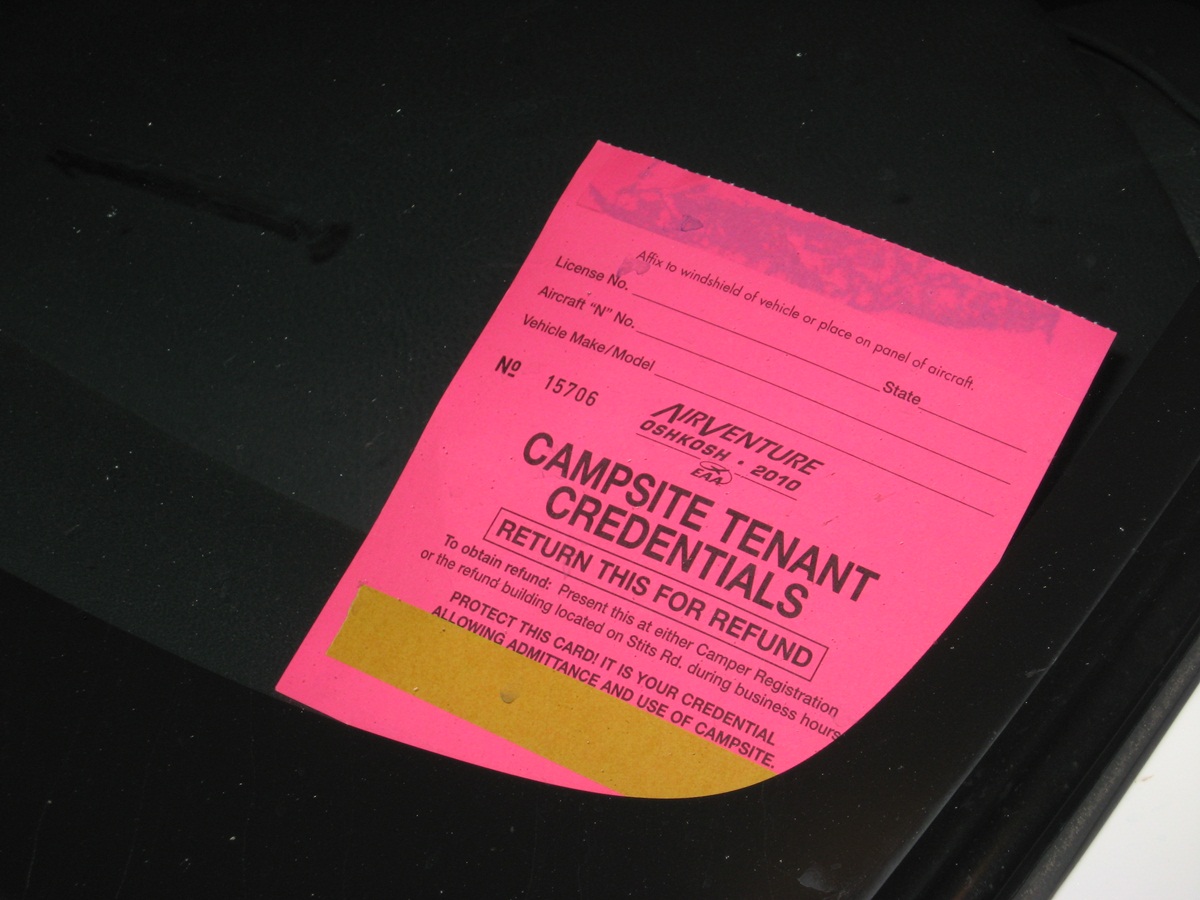
I awoke fairly early this morning, looked out the tent and saw this...
The line from yesterday afternoon was gone; I don't know where it went, I've seen no indication anyone was allowed into the campground at AirVenture. But it was replaced by another line that stretches about a mile down the road. It's not moving and it doesn't appear it's going to move anything soon.
After breakfast, I went out and talked to some of the people.
Nate Gifford, from Worthington, Mass., and he flies for Continental. He and a couple of friends from the Berkshires (who didn't want to be identified but we exchanged some Berkshire County connections) drove all night from Massachusetts, and pulled into line at 5:30 this morning.
Nate was in pretty good spirits; he's been coming here since the '80s and didn't seem to mind waiting in line much. His colleagues are on their first trip to Oshkosh.
This gentleman is from my neck of the woods -- Oakdale, Minnesota. Kirk Martenson is ex-Army where he flew helicopters and he's looking forward to evaluating some of the kit helicopters. He says EAA could've done a better job of posting signs that say "go home."
As he understands it, EAA is going to organize a caravan to the parking lot at at the University of Wisconsin Duluth, where they'll drop their trailers. What happens after that, I don't know, and this isn't official so don't quote me.
From looking at some of the shopping center parking lots, however, it appears that EAA is trying to line up space for these people to put up shop. Various parking lots along S. Koeller Ave -- the frontage road -- now sport mini-neighborhoods.
This group is from St. Louis, the president and vice president of EAA Chapter 32 in St. Louis (on the right). David Doherty and his son, William Doherty. David proudly points out he was born on the day the EAA was formed in the basement of Paul Poberezny's Wisconsin home.
The people on the left are all from Australia. Dave Looten and Rae Percival are here for his 60th birthday. They've been traveling in the states for seven weeks and are now taking in Oshkosh and all its, at least for now, inaction.
I asked David -- Aussie David -- for his favorite flying experience and he reports that it came just a few weeks ago when he flew over the desert in Australia and found everything to be green, which apparently rarely happens. Everything's green in Wisconsin, too. I told him if he got tired of making camp on a frontage road, the biggest ball of twine in the world is but a few hours away. He seemed appropriately unimpressed.
Last night, I had dinner with Darwin Barrie, and Glenn and Michael Brasch, and the pal I know only as "Tom the Camp Locator Shack Guy," and Jeff Point, who is the master parker of RV aircraft. Jeff says the "phrase that pays" this week is, "I've never seen anything like this before," and describes the situation as a "Biblical flood." He says at this point, organizers are just "making it up as we go." There's no long-term plan, because people are just trying to figure out what to do in the short term.
They can't even park cars for people coming in today (although AirVenture officially opens tomorrow) because the fields they use for the parking lot are too wet.
EAA officials have fanned out around Camp Scholler, telling people they can't drive their cars once they set up camp; they have to walk the half mile or so to a shower or the store or wherever. The cars are simply carving up the field.
That wouldn't be such a bad thing if the camp shuttle buses were running, but I haven't seen them yet and if they are running, they're going to have a difficult time because of all the big land yachts parked along the road.
And the owners of those rigs aren't sacrificing much. Even though people need to use the road, those that have living rooms that extend out the side, are deploying them, carving up more of the road. Thanks for taking one for the team, rich folks. Stay classy.
I did hear this morning from my favorite vendors -- Jerry Hansen and the gang from Trio Avionics, who were driving in to set up their shop. Hopefully, we'll be able to get together for dinner as we always try to do.
My friend, Warren Starkebaum, is due to fly over from Crystal Airport (Minneapolis) today. I left him a message saying "you don't want to be here."
Normally on Sunday, one can pass the time pulling up a chair by the runway and watching the mass arrivals. But there are no mass arrivals because there's simply no place to park them. There will be soon, Jeff hopes, but there are going to be large sections that simply won't hold the weight of airplanes this week.
The big fly-in of DC-3s has been canceled. They take up too much parking space on the ramp, space that has to be reserved for smaller planes.
(Click on the images to see larger ones and to see what's cut off from the smaller ones posted here.)
This blog is a collection random musings on the state of general aviation and some of the interesting stories that abound among pilots.
Sunday, July 25, 2010
Saturday, July 24, 2010
Oshkosh Diary - July 24, 2010
It's a lovely evening in Camp Scholler at AirVenture 2010 in Oshkosh... as long as you're looking up. Glance anywhere else, and you're looking at a looming disaster, at least for a few days until things dry out.
They've had over 10 inches of rain here since the beginning of the month and it shows. The little creek where I usually camp is running like the Mississippi.
As for airplanes, I've seen very few fly in. Michael Regen is here. I'll be doing a story on him and his soon-to-be bride. He's parked his RV on the tarmac near the FBO until they start parking planes on grass.
His wedding on Tuesday will be in the North 40. Here's what the North 40 looks like right now.
And here's what it looks like in the campground:
The spot I'm at is working out fine for now. I'm half-deaf so maybe the truckers blowing their horns in the middle of the night won't bother me as much. But I come over here mostly to socialize and there isn't much of that out here. People don't walk by on their way to somewhere else. Out here, you've got a golf cart or a car to get where you need to go.
Glenn Brasch, his son Michael, and Darwin Barrie were setting up their site across from where they used to be near the camp locator shack. I almost got the car stuck when I stopped to say "hello." I now have a generous coating of mud on it.
There's no working wiFi yet. This year, EAA has built small buildings around the area as wiFi hotspots, which I presume means you won't be able to sit in your tent and watch Hulu this year. Good. But it doesn't appear to be turned on yet.
So I'm down at Starbuck's where a barrista who used to live on St. Paul's East Side asked me if I'm in town for the air show. "Do I scream 'air show'?" I asked.
"No," she said, "it was your TCF Bank card. But, you know, you fly people are pretty well dressed. Usually we get beer guts and sandals in here. I was wearing muddy sneakers and a T-shirt. I chose not to show here my beer gut.
I suppose I could've pursued it and ended up at the point I dread ("you pilots are all rich."), but I'm tired and I still have to work up the energy get over to WalMart and navigate around the -- apparently -- Starbucks customers.
Drop a note if you have questions or comments and we'll be conversing here during the week.
They've had over 10 inches of rain here since the beginning of the month and it shows. The little creek where I usually camp is running like the Mississippi.
Out on the frontage road, at least a mile long line of RVs (the kind on wheels) are stalled. They're not letting them in and some EAA people are going RV to RV handing out water. Inside Camp Scholler, only tenters are setting up. The RVs and other big units are mostly parking on the roadways and setting up there. It's a nightmare.
I looked at the EAA Radio compound where I was going to set up and decided that -- at least for tonight -- I'd head for high ground. I'm out on Second Street, which is a healthy stone's throw from the highway. But it's not standing water and my standards for comfort got lowered considerably. Tomorrow, perhaps, I'll move in with my broadcasting friends.
As for airplanes, I've seen very few fly in. Michael Regen is here. I'll be doing a story on him and his soon-to-be bride. He's parked his RV on the tarmac near the FBO until they start parking planes on grass.
His wedding on Tuesday will be in the North 40. Here's what the North 40 looks like right now.
And here's what it looks like in the campground:
The spot I'm at is working out fine for now. I'm half-deaf so maybe the truckers blowing their horns in the middle of the night won't bother me as much. But I come over here mostly to socialize and there isn't much of that out here. People don't walk by on their way to somewhere else. Out here, you've got a golf cart or a car to get where you need to go.
Glenn Brasch, his son Michael, and Darwin Barrie were setting up their site across from where they used to be near the camp locator shack. I almost got the car stuck when I stopped to say "hello." I now have a generous coating of mud on it.
There's no working wiFi yet. This year, EAA has built small buildings around the area as wiFi hotspots, which I presume means you won't be able to sit in your tent and watch Hulu this year. Good. But it doesn't appear to be turned on yet.
So I'm down at Starbuck's where a barrista who used to live on St. Paul's East Side asked me if I'm in town for the air show. "Do I scream 'air show'?" I asked.
"No," she said, "it was your TCF Bank card. But, you know, you fly people are pretty well dressed. Usually we get beer guts and sandals in here. I was wearing muddy sneakers and a T-shirt. I chose not to show here my beer gut.
I suppose I could've pursued it and ended up at the point I dread ("you pilots are all rich."), but I'm tired and I still have to work up the energy get over to WalMart and navigate around the -- apparently -- Starbucks customers.
Drop a note if you have questions or comments and we'll be conversing here during the week.
Friday, July 23, 2010
On to Oshkosh!
Got in from a quick trip through Boston this afternoon and immediately headed for the hangar and packed the car for the trip to Oshkosh. There was quite a bit of activity with amphibs -- more so than usual, since Wipaire is on the field -- but driving out I saw this beauty.
I'm not one of the people who can identify every airplane out there on sight, I just know that that's a mighty fine job of polishing aluminum.
Anyway, I'm not sure what to expect at Oshkosh this year. It's been raining -- hard. They got about 7 inches of rain yesterday, I understand.
I hate mud.
I'm not one of the people who can identify every airplane out there on sight, I just know that that's a mighty fine job of polishing aluminum.
Anyway, I'm not sure what to expect at Oshkosh this year. It's been raining -- hard. They got about 7 inches of rain yesterday, I understand.
I hate mud.
Sunday, July 18, 2010
One more autograph
I've written several times before about the number of "autographs" that are hidden around N614EF. As people would help, I'd ask them to "autograph" the part they helped on. It's fun to be working around the airplane and see an autograph from eight or nine years ago, documenting a day I'd forgotten about.
Today, I added another autograph because the "helper" wasn't able to.
Jennifer Helen Collins, my niece, died this morning.
Jennifer was born with Spida Bifida, the oldest of my twin brother's four children. She could walk with crutches, but for the most part, the wheelchair was her constant companion.
I looked around the airplane this morning looking for the perfect spot to add her "autograph," finally settling on the inside of the right wing, in honor of my brother's love of politics.
Jennifer Helen Collins
12/1/78 - 7/18/10
She couldn't walk, but now she flies
Saturday, July 17, 2010
Countdown to Oshkosh
At this time next week, I'll be at Oshkosh, spending Saturday with a tape recorder in one hand, a camera in the other, putting some stories together for EAA Radio and also getting some pieces together for Letters From Flyover Country.
As in previous years, I'll be posting several times a day here and I hope you'll follow along. I tend to look for the comedic or at least slightly off-the-beaten path anecdotes so I'm probably not going to be a good source for the last technology that's unveiled at AirVenture.
Besides, there are plenty of other places to get that. But nobody else has written about the Porta Potty Prayer (Which you can find in this classic post).
As always, it's a lot more fun doing this if I know you're out there reading it. So please comment often.
What's the code?
While I'm building my own airplane, I don't fly that often. Truth is: I didn't fly that often before; only enough to keep 90-day current at Thunderbird Aviation in Eden Prairie. But last evening was the night for some practice.
I took the rusty bucket -- err, N4337V -- out to Glencoe for some landing practice and for reasons I still can't explain, I bounced almost every landing. The sun was setting and I was landing on Runway 31, so visibility wasn't the best, but it wasn't the worst either.
My airspeed and approach was perfect. Attitude good. Altitude proper. Airspeed dead on: 64 knots "over the fence." Bounce...bounce.
You can learn a lot even when things aren't going well. You can evaluate and work on your judgment, for example. On one landing, I bounced once....then twice, which was two times more than was acceptable. So I "firewalled" the throttle, dropped a notch of flaps, lowered the nose to pick up airspeed and executed a pretty fine go-around, if I say so myself.
That, actually, is a talent few pilots practice. When people get into trouble, it's often because they don't want to admit they're in a bad spot and take action to set up for another try. They try to "save" the landing. So that's a positive.
On another time or two, I reacted to the bounce with a touch of throttle to ease the plane -- more or less -- onto the runway rather than have it "drop." On every landing, I consider "what would happen now if this were my RV?"
If this were my RV, I'd be able to go back out this morning and get it right. But an hour and a half of rental time is $180 and, well, it'll be cheaper just to think about it while mowing the lawn and folding the laundry today.
As I was coming back into Flying Cloud -- I was just south of Waconia -- another problem developed. "Flying Cloud Tower, Warrior 4337V is 10 miles out, with Bravo, inbound landing." Silence. Ruh roh.
A moment later, another warrior announced his intentions to land and he was two miles behind me. A moment after that, a third Warrior announced he was in the general vicinity. So I reannounced my intentions. Nothing.
"This isn't good," I thought. I've got two planes around me somewhere, a tower that I can't talk to, and a setting sun messing with my visibility.
As you pilots probably know, the mantra here is "fly the plane." And I did, though I admit my altitude decayed from 2500 to 2200 as I circled to avoid getting any closer to Flying Cloud's Class D airspace without being in radio communication. I peeled off to fly south, away from where I figured my two new friends were.
I tried to diagnose the problem, checking cables, frequencies, volumes etc. I could hear the conversations taking place -- none involving me -- but I couldn't participate. As I circled, I'd be blinded when I turned toward the west, a most uncomfortable feeling.
I finally decided I was going to have to go "no radio," which involves changing the transponder code to a discreet setting that tells controllers that my plane is unable to communicate. They then use a red and green "light gun" from the tower to give me instructions (although I'm pretty sure the tower would've radio'd me to see if I could at least hear them, in which case there wouldn't be a problem.)
All I had to do was change the transponder to the appropriate squawk code which was.... ummm... 7700.... 7600.... 7500... oh, shoot, which code is it? I knew it's not 7700, because that's the setting for an emergency (I remember that for some reason by remembering the first two numbers are Ray Bourque's uniform number when he played for the Boston Bruins. Hey, whatever works!).
So it's either 7600 or 7500. One is for loss of radio, the other is to signal a "hijack." Since the horizon has big skyscrapers of a major American city (Minneapolis), I didn't want to get it wrong, because the response was going to be decidedly different.
My kneeboard has a "cheat sheet" on it which tells me the light-gun signal meanings, but it didn't have the proper codes. So as I circled in the blinding sun, my altitude decaying slightly, I went through my flight bag, looking for anything that might have the proper code. Of course, papers were flying everywhere by now.
I finally found it. 7600 (Which I will now remember by associating "76" with the year I graduated from college and didn't call home enough. Get it? Communications failure. Hey, whatever works!)
I switched the transponder and hit IDENT which, presumably, lit up the controller's radar screen, but I didn't hear him saying anything to anyone else flying near me. So I as I turned toward the field, it occured to me that I had changed the PS Engineering 4000 intercom early in the flight to give me "sidetone," the ability to hear myself in my headphones when I transmitted.
Sure enough, I had flipped an extra switch and somehow prevented transmitting. Of course, this also meant that all of my radio calls for the last hour out at Glencoe weren't going out either.
"Flying Cloud Tower, how do you hear 4337V?" I radioed.
"Warrior 4337V, loud and clear, sir. Confirm that was you squawking 7600?"
So I did, and got squared away from the approach and landing. Other than another bounce, I landed uneventfully, taxied back to the FBO and shut down the plane (by the way, nobody parks a plane better than me. Nobody.)
It was a pretty good workout that identified more areas to work on the next time I scrape together $180 to find out I need to be better at flying airplanes.
Thursday, July 15, 2010
Meeting Miss Mitchell
Julia Schrenkler, interactive producer for Minnesota Public Radio, time traveled to the exotic land of South St. Paul yesterday, from where she filed this report.
There's history in Minnesota. Some stories are undiscovered, and others can be found if you're willing to visit Hangar #3 at Fleming Field in South St. Paul.
The Minnesota Wing of the Commemorative Air Force tends and flies some of the aircraft that shaped history. The goals: preserve and educate. They restore, maintain and show the planes. The Quonset hangar a short distance from the Twin Cities International Airport is the home base for the flying machines and the people who love them.
The planes dominate the aircraft entrance area while maintenance tool chests are scattered around the edges. In the back are historical displays (complete with propaganda and a collection of unopened rations) and where the men in uniform were waiting.
These men aren't pilots. They're not a functional flying crew. They're re-enactors and they were willing to deliver a crash course on their passion for history.
The pursuit of historical truth
"We're research geeks," Eric Cheever said, "I've always been obsessed with history, and I read as much of it as I could." Cheever seems to favor researching mid 20th century events and explained his father's friends were WWII veterans, "To sit and hear this history from a participant - you can't get that from a history book." He explained that once he started re-enacting, his understanding of what these people did "took a quantum leap in understanding."
But you may get it from someone willing to research it, experience it, and expose you to it.
The search - and perhaps rescue - of lost information is a first focus for the group. Troy LaFaye has ten years of reenacting experience. He simply stated, "If we are not historically accurate, it defeats the point of the hobby." LaFaye carefully elaborated that this activity isn't a glorification of war, but to demonstrate the people involved in the war and life at that time suffered. It is also LaFaye's goal to share that knowledge, "A lot of people that join think it's like playing airsoft or paint ball, but the whole point of reenacting is not to go out and 'play Army' by shooting blanks - although that's fun - the whole idea is to commemorate the men and women who were involved. The purpose is to teach history to other people, like a live version of a history book."
Gearing up to be living history
Eric Cheever suited up, gives a gear lesson.
It comes across as an intense hobby. While Michael Wells recorded the video of Cheever (above) re-enactor Darren Byrnes showed me some of his aviation gear. One piece, the packed parachute, looks like an overstuffed and unwieldly heavy messenger bag. I picked it up to get a sense of its weight and Byrnes laughed a little, "It's stuffed with a pillow." The parachute container is a mass of clips and webbed handles, designed to be quickly attached to a crew member. Byrnes showed me that they were actually stowed within arm's reach or loosely clipped at chest level, unlike the backpack-style system most people associate with parachutes. His next project relates directly to that life-saving device: working with Cheever to create their own parachute harnesses to complete their period-correct aviator uniforms. eBay was a source for the harness webbing, and the men will stitch them from scratch. Eventually a parachute equivalent will be in the pack, although Byrnes noted it would clearly not be safe or functional equipment.
Going to market
Not everything is hand-sewn or perhaps a family hand-me-down, there are collectors and sellers actively trading in historical pieces. Steve Shumaker tells me that the cost varies. "It depends on the market." He explained that a wealthy or avid collector can quickly and perhaps unwittingly create demand and drive up prices. Culture and media can affect cost, as even history has trends and fads. Shumaker gave an example, "'The Pacific' came out on HBO, and the Marine stuff is really big now!" Shumaker also notes that authenticity is expected, and that the group was onces called to task about their uniforms,"'Line up and let me see what you got wrong' the WWII vet said. After looking them over for a couple minutes, the vet shrugged and said 'Not a thing.'"
Meeting the Miss Mitchell
The group eventually moved towards the big plane, the main draw, the Miss Mitchell. A B-25 bomber, she looks big from a distance but surprised me with her actual size in the hangar. Aside from wing span, the plane actually seemed... small. I bet her main body couldn't be more than 12-15 feet longer than an average city bus. Although her physical size surprised me, her solidity didn't. Her panels are heavy under hand and riveted at consistent distances, giving her an armored appearance at certain perspectives.
I saw the re-enactors gravitate to her. LaFaye couldn't seem to resist looking at the plane or keep from smoothing the panels. They kept moving around the aircraft, explaining the crew's experiences and different roles between quiet gazes at the plane.
Boarding the plane is done alone. There's no jet bridge on a bomber, but multiple drop ladders that allow for one person to get into place at a time. We took breaks between entering the different assignment seats. Everything is a tight fit. Shumacker is 6'4" and broad-shouldered, but he showed no hesitation moving into the pilot's seat. I gamely tried to be graceful in the tight spots like the steel tunnel to the bombadier's position, but compared to the light and open space in the hangar the B-25 is dark and almost counter-intuitive inside. Everything seemed at odds with my perception of where I was actually at in the plane.
For example:
The mid-gunner's seat, shown here currently stowed perpendicular to the body of the plane. During flight, the seat ratchets up to 90 degrees. (Independent video of the turret in operation) It probably tested the best stomachs during banked turns.
It wasn't until I took the tail gunner's position that the re-enactors' messages finally clicked for me. Sitting on the equivalent of an old bike seat, with a 280-degree view but a small gun sight, trigger handles close and only one small constructed exit in an odd and difficult spot behind me... I got it. The vulnerability and violence in such a small space was overwhelming.
The crew member that staffed this position was likely half my age at the time of the war. He straddled a small seat with steel under him and clarity to the sides and above, seeing the entire flight mission move backwards away from his perspective. At any moment he could possibly be the first to spot enemy fire coming directly towards him. His tools were two machine guns mounted to the frame but practically in his lap, their workings literally zipped-in with nothing but heavy military fabric to the tail of the plane so they could be maintained without removal. I remembered the plane's enormous engine and exhaust noise from a different visit to Fleming Field, I considered what it would have meant to think about that fabric barrier but a foot or so away, and the threat of a forceful wartime death at so young an age.
Those impression aren't in this slideshow, but are a direct result of this history visit. I owe that moment to the re-enactors.
The Minnesota Wing of the Commemorative Air Force has open hours and hosts events at the hangar, such as charity open houses and food & drink events, like "Hops & Props."
Wednesday, July 14, 2010
He's living my dream

There are worse ways to spend the day, I suppose, than the way my son got to spend his today. He's a paramedic and he just moved up in his company to critical care work in western Wisconsin. On his orientation today, he familiarized himself with the evac helicopters.
The company also has at least one Falcon jet (he had ridden in one of these months ago for a patient transfer).
He snapped this picture in the company hangar.
It looks like the perfect job for an aviation buff, if you take away all that blood and such.
Monday, July 5, 2010
Bright lights, little airplane

If nothing else, any time you can get a full instrument installed, wired, and powered up in one session of work, I think you've done OK.
Today I checked off another item on the big dry-ink board in the hangar: Install fuel level indicator.
The Electronics International fuel level indicator has two separate power wires -- one to power the instrument and one to to power the backlight, and a wire for each ground, then you run wires out to the fuel tanks.
I ended up following the headset wires to the left and right, then tie-wrapped to the fuel vent line to the floor and then out the fuselage. Because the fuselage is double-walled, the snap bushing doesn't extend out of the fuselage. I'll put a dab of RTV in to cushion things.
Here's one side at the fuel tank:

And here's the other:

To keep vibration to a minimum, I ran the wire through a couple of inches of static tubing, which is a very hard plastic, and secured the line to the fuel line.
After checking everything, I powered it up. My family, which occasionally recalls when I was kid, my riding my bicycle five or so miles to watch traffic lights in Newburyport, Mass, will understand why I like this instrument so much.
I actually don't remember that much of the installation process, which took about three hours; I was thinking of my niece, Jennifer, and my twin brother, Bill. Jennifer's in the hospital and isn't doing well. I called Bill who was on his way to the hospital to let him know I'm thinking about them both and hoping for the best. If I could trade this damned plane in to make it so, I would in a second.
There a lot more items on that list on the dry-ink board. But I think for now I'll pull up a chair by the hangar door, and watch it rain for awhile.
Thursday, July 1, 2010
A new instrument

I can't say I was particularly thrilled about cutting a new hole for an instrument in a panel I'd already painted -- there's really no way to avoid some scuffing in an operation like that -- but on the other hand, I've always really liked the Electronics International fuel level gauge, which has a descending series of LED lights to indicate fuel level in each tank. I've always liked pretty colored lights.
And, as it turned out, the Grand Rapids EIS (engine monitoring system) is better for the fuel flow indicator than the fuel level, so I wanted two data references in the panel to track this sort-of important thing. Plus, the EIS seemed kind of lame in the wiring, requiring a resistor to be connected between the wiring and the fuel level sender in the tank.
So today I punched through a new hole, and installed the EI fuel level sender. That's it just above the red knob (the mixture regulates the fuel and air mixture). Glad I left a little expansion space in my panel design.
I should be able to get it wired up pretty quickly. It's very simple, from what I can tell. Even I can't screw it up.
Next to it is the TruTrak autopilot. I have a wing leveler system but haven't been able to wiring it up fully yet because of some questions I have about how it's tied in to the GPS.
I sent a note to Stein at SteinAir but haven't had a chance to get together with him yet, but maybe you can help in the meantime. Here's the questions:
On the the transponder, there were two wires remaining with no apparent home:
SERIAL OUT 1
SERIAL IN 2
My setup is the Trutrak single-axis and the Dynon D100. The only GPS I have is a Garmin 296 in an Air Gizmo, although I'll probably upgrade to a 496 before I'm flying. Do these two wires have significance with my equipment and if so, where and with whom do they mate?
I'm also looking at the TRUTRAK harness kit with these 6 loose colored wires:
RED WIRE -- Power (I know what to do with that)
BLACK WIRE - Ground (I know what to do with that)
BLUE WIRE - Serial input from GPS (I bought the GPS Garmin cable, I assume this attaches to "Blue: Port one out" or "Violet: Port 2 Out". Is this correct? If so, does it matter which?
YELLOW - Dimmer (I know what do do with that. I think)
GREEN - To Altrak Pin 9. Since I don't have Altrak, I assume I just insulate it and wait for the lottery to do its thing.
WHITE/BLACK - To control wheel switch (from pin 2). I have on idea what this refers to. What control wheel switch?
Meanwhile, I have about three or four instruments with wires to a dimmer. Anyone want to guide me on how I would wire several instruments to one dimmer switch?
Tuesday, June 29, 2010
VP-50 software upgrade update
When I sent my Vertical Power VP-50 back after my failed attempts at upgrades, I included the cable you have to make to accomplish upgrades in with the package, with the hope, actually, that it would reveal a problem. Nothing else explained the stalled upgrades, and yet when I checked continuity, everything checked out fine. I didn't want the problem to be either the control unit (CU) or switch unit (SW), nor any incompatibility with the computers I'm using to update.
Fortunately, John at Vertical Power found the problem -- it was, in fact, the cable I made. He upgraded the unit, and is sending it back, with a new cable, too. You can't beat that service with a stick!
As it turned out, it's just as well I had to pull the system out and send it down to Albuquerque for some professional help. I made some changes in the system's location, moving it closer to the center of the subpanel assembly to move it away from a wiring run. And I also changed the way it's mounted, adding some nutplates so that it now screws into the brackets that hold it in place, rather than bolt it in place. And I added a nutplate or two to put some Adel clamps on the brackets to assist in some wiring runs.

In the meantime, I determined that the Grand Rapids EIS 4000 isn't going to provide the visible fuel level monitoring that I want (although it will provide flow rate information, which is possibly more valuable), so I ordered an Electronics International dual fuel level indicator (about $400) for the panel, instead. And having the VP-50 system out will make it easier to drill the holes in the panel to insert it.
Plus it has pretty colored lights.
Friday, June 25, 2010
I got your shipping right here
An order from Aircraft Spruce arrived today. Now at the end of filling out the order, a little postage calculator said it would be about $15 to ship it.
Here's the order:
20 small stop nuts
4 small ring terminals for a 1/4" stud
10 screws for mounting instruments
3 cubic feet of soundproofing material
1 4x4 piece of .063 aluminum
4 feet of 3/4 .063 aluminum angle.
Total of the parts $65.15.
Cost to ship: $115.63.
I also ordered a $400 Electronics International fuel level instrument today, too.
At the rate I'm on,it's starting to look like I'll wait until next winter before ordering a propeller, which probably puts me a little behind on the cowling. I'll likely work on finishing the electrical system and running some fuel lines, but it's pushing the first flight back to, probably, 2012.
Top 10 Aircraft Wiring Mistakes
Marc Ausman at Vertical Power has penned a new paper, "The Top 10 Aircraft Wiring Mistakes (and How to Avoid Them)." I'm almost done with my aircraft wiring and I learned a few things, too. I'm not sure that's good or bad. I also helped edit the paper.
Here it is.
Here it is.
Wednesday, June 23, 2010
Countdown to Oshkosh
It's been a long time since I've gone to Oshkosh with an open datebook and things couldn't be shaping up better.
I'm going to be working with the fine people at EAA Radio this year, hopefully producing several segments that mirror what I do with my day job: Profiling average folks doing extraordinary things. Know of some? Let me know and we'll make you a star.
The station manager, Jim Gray, says he's giving me carte blanche to go find things I find interesting and I've already found one. An RV acquaintance is getting married on Tuesday at Oshkosh. And why not? That's where the happy couple met. How neat!
EAA has been tearing up Camp Scholler to provide electric/water hookups to the people who want to pay for them, moving the 24-hour generator area out to the field by the West End store and generally displacing me from the spot I've had for the last six or seven years, but even that's turned out well.
The EAA Radio folks are reserving me a spot in their compound in Paul's Woods. What could be better? Woods? Trees. Shade. And even better: A never-ending party a stone's throw from the entrance to AirVenture?
Yes, I'll be doing my daily (sometimes several times daily) Oshkosh update here on Letters From Flyover Country, and Jim says I'm free to use the material I find for EAA here on the blog, too.
The other day I pulled the camping gear out of its spider-webbed corner of the hangar and ordered new aluminum poles from the tent company ($48 each!) and a new rain fly ($120!).
It's going to be a great year at Oshkosh!
Monday, June 21, 2010
How much do free software upgrades cost
I finally gave up on the notion that I'll ever be able to do a software upgrade of the Vertical Power VP-50 unit today, packed it in a box and sent it back to Albuquerque where people smarter than me can figure it out.
I thought that getting new features free would be a neat thing and, indeed, it is, except for the "it's not really free" part in real life.
Here's what I've spent so far:
Serial to USB converter cable - Radio Shack - $49
New laptop because the desktop PC erased software but didn't install - $436
New serial to USB converter cable under theory that that's the problem - $15
Postage to mail the unit back - $10.05
$1,500 of postal insurance - $16.70
Delivery confirmation - $.80
Total cost so far: $527.55
But, really, it's more. With the software upgrade, Vertical Power made a wig-wag feature available, which convinced me to buy and install another Duckworks landing light. Cost: $85
I notice the other night -- I had a really bad week of airplane building -- the lens is cracked. That'll need to be replaced. That's $15. Maybe I'll order two.
I'm hoping that Vertical Power can find something wrong with the unit itself, or the cable I built because if it's just a matter of temperamental computers and cables, that's a honkin' waste of money without getting it to work.
Subscribe to:
Posts (Atom)