There are days like I wrote about the other day when nothing goes right. Then, there are days when some time on the RV airplane project can get you back on track and feeling chipper. Today was one of those days.
It being the Martin Luther King holiday, I had the day off, so I headed to the hangar this afternoon to get a few things figured out. The antenna run for the transponder was one of them. The run for the push-to-talk switch on the yoke was the other.
It was 34 degrees at the hangar and thanks to Mr. Carhart and a small kerosene heater, it was relatively springlike. The radio was pumping out NPR (and MPR), which gave me the opportunity to listen to the entire "I have a dream" speech from King, when I realized -- and I'm ashamed of this -- that I've never heard the entire speech.
You neither? Well here.
One thing I like about building at the hangar is I can get smarter about so many things while I build. The speech was followed by a discussion about what "post racial" looks like in the real world. But I digress...
I've spent a lot of time trying to figure out the best way to run the transponder antenna. I was going to run it up the small bulkhead where I've mounted the headphone/mic jacks, but eventually I decided to run it down the center channel, somewhat away from other electrical connections.
I don't have a lot of buttons on the yoke, so the push to talk wiring run was a little easier. Both end up in the same bay.
The push-to-talk wires have an adel clamp, then a tie-wrap, and then a terminal strip. I have a ton of Adel clamps and I use them religiously. Another wire comes down the from the mic/headset jacks (I'm using black snakeskin and a dark gray interior so nobody will notice).
I'm very conscientious about not letting the wiring turn into a rat's nest, and being a little -- or maybe it's a lot -- OCD, I will put an Adel clamp in when I run one wire, then remove it and put a larger size in when a second wire comes along.
The wires here are the transponder antenna, the push-to-talk switch wire, and a wire for left nav light, which will terminate at a terminal strip. After they go through the main spar, the push-to-talk wires go straight to the bulkhead and then up to the jacks, the antenna wire follows the wiring run forward of the spar, and then down the left side of the center channel. I added a bushing in the forward heater cover to bring it up the firewall and -- at some point -- to the transponder.
It's a good thing I'm a relatively thin guy because getting in and out of the small space in the cabin takes a ladder and some contortion. I also stumbled across other things that needed fixing. The cotter pin hadn't put in the yoke bushing nut, and the control assembly was hitting -- slightly, but it counts -- several of the ribs. I fixed both.
You wouldn't think all of that would take four hours, but that's how long it took. Lots of in and out of the cabin, and lots of swapping of tools, and lots of pulled hamstrings.
But it got me back on track and I got some decisions made.
I was at a meeting at my workplace on Friday. A group of the "best and brightest" were charged with coming up with a likely scenario for what my industry would look like in the post-Broadband-initiative world. About 20 minutes into the conversation -- in the break-into-small-groups stage -- I found myself thinking, "I should've gone to grad school instead of gone into radio." That was a moment after I found myself thinking, "Man, these people are way smarter than me. What am I doing here?"
As you advance in your working years, you reach the point where you realize that the working world has passed you by, and you're just trying to hang on. I've reached that point. I had no business being in the room.
So a trip to the hangar on Saturday -- the temperature reached the summery 30s -- offered the opportunity for some "therapy" against the psychological ravages of a week at work. Unfortunately, for people like me, an RV airplane-building project can also make you feel stupid from time to time. Saturday was one of those days.
I had hoped to run an antenna cable from the transponder antenna to the transponder, but I struggled with the BNC connector. I couldn't figure out how to crimp the small pin on with the crimper I've got. One ruined BNC connector later, and feeling stupid -- I moved on to putting the new alternator on.
"Disconnect the battery," the instructions said. I knew I was supposed to remove the ground cable first; I really did. But I put the socket wrench on the positive stud first anyway. I don't know why. When the wrench hit the firewall, sparks flew. A minute later, I noticed the hole (above) in the firewall. I might as well have been welding. Stupid.
I drilled the hole out to a ragged #30, and added a new item to the "to do" list on the whiteboard: "Fix hole in firewall." I'll have to make a doubler plate and cover it. Just something else to do.
I moved to the alternator and, funny, I couldn't figure out how to mount it properly. Stupid. Three strikes, I'm out.
I stopped by an RV-building neighbor on the field and looked at his set-up, then returned to the hangar and loosely bolted the alternator on (not sure which way the belt goes). I had to get something out of the day.
But it was one of "those" days, a day when every step not only feels like two steps back; every step is two steps back.
Around 4 this morning, I found myself tossing and turning and thinking about the hole, and the doubler plate, and the BNC connectors, and all the other things I have to do on the engine and panel before the plane flies. And the fuel line has to be punched through the firewall. And the heater box cable. And the mixture and throttle controls. And... and... and... on and on. I tossed-and-turned more because it was starting to feel like it might be too much for me.
At 6 on a Sunday morning, unable to sleep, I got up to let the dog out and grab the paper and read about the people of Haiti.
I might be stupid, but if a ruined BNC connector and hole in a firewall is the biggest problem I've got, I'm pretty well off.
Update: I slapped a doubler on the inside of the firewall. Some poorly driven rivets there but I'll Pro-seal around the edges. I'm not going to drill these out and risk further woes. It's just that kind of weekend.
If you're an airplane homebuilder, you should start to get in the habit of going to the EAA video tips for homebuilders before wasting a lot of time searching all over Googleland. EAA has produced hundreds of videos over the last few years and they're indexed well enough to easily find what you need.
Today, since the temperature his 30, I'm heading out to the hangar to run some antenna cable to the transponder and transponder antenna. I spent some time looking on AeroElectric Connection for a "comic book" on BNC connector installation, and I'm sure it's there somewhere but the search and navigation function on the site isn't really very good.
In some degree of desperation, I went to the EAA site. Guess what the newest video is? BNC connectors, taught by Dick Kohler, who taught the SportAir workshop on avionics that Warren Starkebaum and I went to a few years ago.
I'll be honest with you. I live in a metropolitan area. The runways are wide and long and sometimes it still seems like I battle to execute a good landing.
So I can only admire the kind of piloting talent that goes into something like this.
Two Sequim men killed in a single-engine plane crash north of Sequim Valley Airport on Friday were experienced pilots who were well-respected in the aviation community, the airport president said Saturday.
Carroll "Jeep" Larson, 68, of Sequim was the owner and pilot of the Van's RV8 aircraft that crashed into a muddy field about a half-mile from the west end of the runway.
Robert "Bob" Reandeau Sr., 61, also of Sequim, was a passenger in the two-seat, low-wing experimental aircraft that was built in 2008.
"He was active in the aviation community on all fronts," said Andy Sallee, president of Sequim Valley Airport and a close friend of Reandeau's.
"If you're a pilot in Clallam County, you probably know Bob."
Learning to rivet properly was hard. Making the canopy for the RV-7A was hard. Coming up with the money to buy tools and kits was hard. But you know what the hardest part of building an RV airplane is? Keeping from looking beyond the next thing you have to do on the plane.
As many of you know, this is year 9 of the great RV project and for years when people would say, "When will you be done?", I'd say, "About $30,000 from right now." Funny stuff, but it buttressed my discipline to not let others pressure me in the build. It will be done when it's done. It will be built right; except, of course, for the parts of the plane I didn't build right.
When you get nearer to the end of the project than the beginning, I've found it's difficult to keep that sensibility.
I made the mistake a month or so ago of doing some calculating . If I can get the panel completed this winter and if I can get some engine work done this spring, I can have first engine-start by fall. If I can start the engine for the first time this fall, I could be flying some time in 2011.
Let's hit the Wayback Machine. It's 2001, and I've just taken delivery of the tail kit. "If I can finish the tail kit this year, I can build the wings next year," I said to myself and, thankfully, nobody else. "If build the wings next year, I can complete the fuselage the year after that. If I complete the fuselage the year after that, I can finish the finishing kit and be flying the year after that."
Sure, it was possible to be flying by 2005; lots of people have built an RV in four years. But that was them and their schedule and resources; not mine.
Fortunately, I altered my thinking early on and went with the "it'll be done when it's done" mantra.
So, about a month ago, when I was talking to someone at work, I speculated that I could be flying in 2011. That was a mistake. Why? Because now it put me on something I've steadfastly refused to be on -- a timetable. And once you're on a timetable, you put pressure on yourself to adhere to it. Again, good for some people; not me. I've got plenty of things in my life that have to be done by a certain date; this project is my therapy, not another thing that has to be done by a certain date.
This week provided two examples. On Sunday, I finished installing the PS Engineering 1000II intercom. It was time to plug it into the Vertical Power VP-50 system. When I checked my load-planning worksheet, however, I realized I'd made a mistake. I attached a power connector, assuming I'd assigned it to a 5 AMP switch on the VP-50 unit. I hadn't. I actually had assigned it to a 2 AMP pin, which is a different connector on the other side of the VP-50 control box, requiring a DSUB pin.
What to do? It didn't make any sense to waste an open 5 AMP pin on a 2 AMP circuit, but the wire was too short to simply cut off the connector and install the correct one, and I didn't want to splice in extra wire. I'd have to take the wire harness for the intercom apart, pull the wire out and replace it.
"Screw that," I said on Sunday.
On Monday, I started on the next part of the panel: installing the transponder (a Garmin GTX 327), so that I can then install the ICOM A210 radio and be done with all the radio work. That's when I made another discovery. I hadn't cut through the subpanel for the transponder unit because it's shorter than the A210 radio. Why would I need to? Because, I learned Monday night, there's no room to attach the wiring harness to the transponder without doing so.
I did cut through the subpanel for the A210, but I placed a piece of angle across the bottom of the cutout, and that now presents a barrier for cutting through the subpanel to make room for the connector for the transponder.
Did I mention it was 4 below at the hangar last night?
See, that's the problem; It's entirely uncomfortable at the hangar; it's far too cold to be working on metal parts with bare hands. And now I've put pressure on myself to get the panel done over the winter, so I can move on to the engine, so I can start it by fall, so I can be flying by next year.
"Screw that," I said to myself after a night of tossing and turning.
The plane will be done when it gets done. The VP-50 needs to be removed, the intercom needs to be removed, and the cutout solution for the subpanel needs to be taken care of. If it's too cold to do it now, I'll just have to do it later. But it has to be done right.
So, sometime this spring, I'll resume work in the hangar, and get the panel done.
I've been wiring up the headphone and microphone jacks for the pilot and co-pilot positions via my PS Engineering 1000II for the last few weeks (yes, I said weeks. It's -14 today.). Now I'm thinking I've been confused into doing it wrong. Yes, I used passive voice there.
Here's why.
I'm using the PS Engineering wiring harness tutorial, which you can find here, if you have Powerpoint.
Here's one of the slides.
It appears to tell me to connect one push-to-talk wire to the tip and one to Audio Lo, the barrel... ground, as I understand it. OK, fine.
Another slide shows this schematic:
So far so good? Good.
Notice that it says connect PTT to tip. Now look at this slide:
Notice the difference? In the first two schematics, it has the PTT wire on the top, indicating that it's the "tip." On the last schematic it identifies the tip as the middle.
Based on the last two images, it suggests one wire comes off the same pole as the ground (Audio LO) and the other comes off the same pole as the audio (AUDIO HI). It appears to me that the schematics in one indicate that audio_hi is the tip and on the other it seems to indicate audio_hi is the ring. In effect -- if you compare image #1 with image #3, it appears to identify a location as a "tip" in one schematic, and then as the "ring" in the other.
Or am I reading it incorrectly?
So, which is it? Let's look to Bob Nuckols of Aeroelectric Connection for help (click for larger image).
To me, that shows the AUDIO-HI wire attaching to the jack without any other wire. Which is too bad because, of course, that's not the way I did it. It's interesting to note that this particular schematic also connects at shield at the jack, which PS Engineering's tutorial says is a no-no. But that's another story for another day.
Update 7:39 p.m. - Armed with the knowledge that there are no electrical symbols here, only a physical reference, I went out to the hangar and got the jacks rewired properly. The -3 temperatures be damned.
January 1, 2010) -- An expanded FAA airworthiness directive on cylinders manufactured by ECI Titan has RV airplane builders scrambling to find out if their engines are covered.
According to ECI, the problem is posible fatigue cracking and head separations on specific replacement cylinders. (Read more)
You've heard, no doubt, about the ongoing FAA effort to curtail runway incursions? That's when planes stray onto active runways, conjuring up images of Tenerife.
Today, I was "that guy," but I like to think I wasn't as clueless as the term suggests.
You see, we had a day and a half of rain after a snowfall, and then a freeze, so the taxiways at Flying Cloud were pretty much straight ice. There's been a lot of construction at KFCM in the last year, too, so things aren't necessarily where they were before.
My currency with the FBO expires next week, so I went out today to shoot some touch and go's. With so much of my money going into building the RV-7A, I don't fly very often -- certainly not enough to be proficient. But I'm aware that one of the problems of homebuilding is that pilots stop flying during the construction period, so I've been faithful to keep flying during the time, if only a little bit. When I do fly, I treat it as a training flight. All of my flights are usually local, and all of my activity is usually practicing air work. I also spend a lot of time reading and educating myself about flying, especially the FAA material on runway incursions.
But sometimes the strategies and procedures for avoiding runway incursions, don't help you much.
The day started bright and beautiful but by the time we pulled the Warrior out of the hangar, the snow showers had moved in. The controller directed me to 28R, but I'd seen its condition and asked for 28L instead. "Taxi to runway 28 Left by taxiways Alpha and Charlie," he said.
My airport map didn't list Charlie, and Charlie didn't use to exist, so I asked for progressives. By the time I reached it, I could spot the bright yellow sign so I canceled the progressive taxi instructions.
Usually, I run-up the engine and do my final pre-takeoff check next to 28R. But the ground controller gave me clearance to taxi to 28L, which gives me clearance to cross 28L 28R. But how long does that clearance last? If I do the "run-up" where I normally do, am I still cleared to cross 28R?
I decided I'd head over to the other side of 28L and do my run-up there. So I crossed the end of 28R on taxiway Charlie. It was glare ice and I was going very slowly. There's a hold-short line just before 28R 28L which I couldn't see under all the ice. But in the construction of the summer, they installed flashing lights. As I approached the line -- very slowly -- I applied the brakes, and skidded. My wheels were on the line (maybe an inch or two beyond), but the forward end of the plane was 2-3 feet across it.
"Tower, I've skidded past the hold-short line," I advised. After a moment, the controller cleared me across 28L and helped me fumble around looking for the runup area.
I spent the next hour shooting touch-and-go's. It was difficult seeing much because frost covered the sides of my windows and the snow showers were making life difficult keeping an eye on a Sundowner in the pattern. But all in all, it was a good hour. None of the landings were particularly good, but none were nauseating either.
As I was downwind for 28L, I advised the controller this would be a full-stop landing, he cleared me to land and when I did, I taxied all the way to the end of the runway and turned off. Ground control cleared me to taxi, and then said "N7337V, possible pilot diversion, call the tower, prepare to copy the number."
I got the phone number and thought, "Oh, sh*t, I bet he cleared me to land on 28R that last time, since that's closer to the FBO."
I shut down, paid for the plane, and then called the tower. "Let me guess," I began, "you put me on 28R on that last down?"
"No," the tower supervisor said, "it was skidding past the hold short line."
He couldn't have been nicer, but said they had to report it as a runway incursion. So he took all of my information after I told him what had happened. He said he doesn't know what happens now, but eventually I'll hear from the FAA. I filled out the NASA reporting form. It's not a get-out-of-jail free card but in assessing the penalty, they take under advisement the "attitude" of the pilot and filling out the NASA form (which provides aviation with safety violation information so they can determine what's a problem and what should change, if anything).
Looking back, I realize there's no way the tower could've known I'd passed the hold short line. I was only over it by a couple of feet, and the line wasn't visible from the tower. But I told them what I'd done and I feel OK about that.
What could I have done differently? First, there was a stack of new airport diagrams at the FBO, but they were covered up by an airport newsletter. The airport diagram wasn't the problem here, but knowing construction had been completed, I could've searched out an updated diagram.
I also could have asked the ground controller to let me do the run-up next to 28R, but the condition of the taxiway and the run-up area was -- in my opinion at the time -- likely to be much better on the other side, and even if I'd done that, I still would've approached the hold-short line.
I could have gone slower, but I was barely traveling at the rate of a casual walk as it is. Plus I'd also tested the conditions three times -- once when I turned onto the taxiway, once at the hold-short line for runway 18, and once just before I turned onto taxiway Charlie. Anytime I cross a runway, I try to get across it quickly, so perhaps I picked up speed a little when crossing 28R; I don't know.
I could've stayed on the ground, but I'd never taxied on ice before, not flown in the conditions that were present that day and I wanted to stretch my experience, especially in the controlled environment -- more or less -- of the traffic pattern. There was a time I didn't do well in crosswinds, so I started flying more in crosswinds. I'm very good at crosswind landings now. That's simply how it works.
But flying is a matter of confidence and when you go out for a workout, ending it with a call to the tower negates whatever 'good' might've come out of the day. On the other hand, it also makes you want to go back out and prove you're focused, situationally aware, and educated. That's a good thing.
This week's overshoot of the runway in Kingston, Jamaica by an American Airlines jet is remarkable in that nobody died. It also provides a fitting bookend to 2009, a year that started with another miracle -- Flight 1549. The flight crew in this latest incident is less likely to be heralded.
Of the many things in this world I don't understand, up near the top is this one: Why don't pilots like to use the radio?
My twin brother was the first one in the Collins family to get a pilot's certificate. Then he paid for my training. We've flown together only once. He stopped flying because he lives just outside the busy Boston airspace and he didn't like talking on the radio. Or so he says.
Today, I was reading a newspaper article in an Oregon newspaper about the idea of adding a control tower to the Aurora airport, the home airport of Van's Aircraft. They estimate that soon there will be over 280 airplanes at the airport making 97,000 take-off and landings at the airport by 2012 with 97,000 takeoff and landings (assuming they're combining the TOs with the landings, that's about 188 flights a year. That's a lot!)
But it was this passage that struck me:
He said that with a control tower, some of those based aircraft will leave because some pilots don’t like using radios. He said the mix of the aircraft at Aurora would change from piston and propeller airplanes, to more turbine powered aircraft.
How is it that people who aren't afraid to get into an airplane and launch into the sky, are afraid to key a button and talk to people?
One of the things I like to do after a flight, is go to LiveATC.net, and listen to how I sounded when making radio calls. They keep an archive of radio traffic from particular airports. And for you homebuilders, it's also a good way to determine whether your radio and antenna are up to snuff.
There's a thread going on at Rivetbangers asking people whether they've calculated how much they've spent on their RV airplane projects so far. I haven't, but I have a pretty good idea.
Unfortunately, I also have a pretty good idea how much I've spent on shipping and handling charges over the lifespan of the project and I'm not sure the two are that far apart.
This week I was about to rivet on a doubler plate for the comm antenna. So I dug out my Avery Tools pop rivet dimple dies -- two nifty little dies that use a simple nail to allow a pop riveter to be used as a dimpler. But I was out of the small nails. So I put the two dies down on the workbench, and went to the hardware store to buy new nails. $1.98 later, I returned to the hangar, only to find one of the dies was no longer where I left it. A search failed to turn up the missing die.
It sucks enough, frankly, that I had to stop my progress and order a new set from Avery Tools (for the record, I LOVE Avery Tools). But what really chaffs me, is that I had to pay $8.95 for shipping. Avery, like many suppliers, don't offer affordable shipping options like, "stick it in an envelope and mail it by the cheapest way ever invented by the U.S. Postal Service."
Yesterday, the package arrived.
Now keep in mind, this is what I needed (actually, I didn't need the nails, nor the other die, but forget about that.)
And this is the packaging it came in:
A waste of packaging, a waste of resources, and most certainly a waste of money. Sticking it in a padded envelope, slapping $1.20 worth of stamps on it and sending it out the door would have been preferable if added as an option.
Van's Aircraft is even worse. In addition to the shipping charges -- which they don't calculate for you when you order something, you only find out later that it averages $11 (although I once spent $85 shipping for a $100 part!) -- they charge you a $4 "handling fee." Think about that: For the privilege of submitting your order, you pay a $4 fee. Why not just tack on extra money to the price?
Update 3:18 p.m. 12/24/09 -- I was doing some laundry over the weekend. There was a fair amount of clanging coming from the dryer, which usually signifies some loose quarters. Nope. It was the missing die. Figures.
All in all, I'd have to say Glenn Brasch is the primary reason I go to Oshkosh every summer. Well, OK, there are some airplanes there, too.
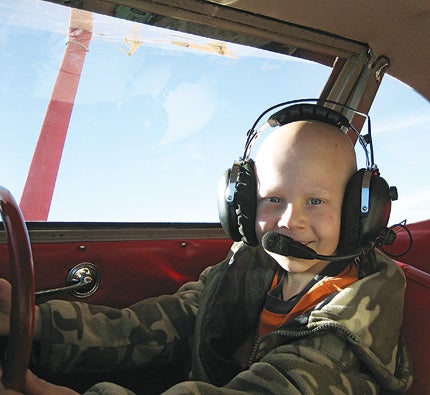
Glenn has written a terrific story in Plane & Pilot about a ride he gave to a kid.
Why would any kid want to do that?” That was the social worker’s response to my offer to take any child flying for free—that is, any child who was a patient at the local cancer center for children. She probably thought I had something up my sleeve, some hidden agenda. I did not. I explained to her that, for me at least, when I was flying, all the world’s problems had a tendency to stay on the ground, and I thought that might be valuable to a child suffering from cancer. She reluctantly posted my offer in the waiting area. I expected my phone to ring off the hook, but I didn’t get a single call for months. I suspected the posting was removed from the wall after my departure.
On Wednesday, the National Transportation Safety Board will release more than 400 pages of material it's gathered in its investigation into why the pilots of Northwest Airlines Flight 188 overshot their Minneapolis destination on October 21, 2009. It will offer no conclusions as to what happened.
I'll be live blogging as I go through the data to see if there's anything new there, and encourage you to join in the conversation with your questions and observations.