An RV-6A crashed bounced in a hard landing, the nose gear collapsed and two people were killed in British Columbia, according to a story today in the Calgary Sun.
The story says a toddler survived, which is interesting since the 6A is, of course, a two-person plane.
Monday, October 29, 2007

Saturday, October 20, 2007
This doesn't crack me up
You know, one of these days, I'd like to complete a significant part on my RV-7A without messing it up. Perhaps I'm overstating things, but these are the days when it doesn't seem like it.
I don't think it's possible to be more careful with the canopy plexiglas than I have been. I won't go into all of the precautions I've taken; just browse back through all the entries. But even so, I ended up with a crack in the canopy this afternoon.

It's a little blurry but this is not the place I expected to get a crack. It's on the farthest aft hole on the right side line.
So what happened? I'm not really sure, but I think it has something to do with two things:
That's the only thing I can come up with, and I hope I'm right. If I'm not, there's a nightmare ahead.
As I've made the latch lugs fit, I realize that the gap between the canopy and the rear window is less than I'd thought. As the latch comes down, since it's moving from front to back, it pulls the canopy down and slightly aft -- but just a bit. This actually was good news since I thought I'd made the gap too big down on the right side.
Instead, I had to do some more sanding today. Because of the discovery of that crack however, I didn't bother putting the canopy back on to check things. Instead, I loaded it in the car, and took it out to the hangar. In the spring, when it warms up, I'll put it back on the frame and see where we are. With any luck, the fuselage will be out at the hangar by then.
In the meantime, I've got some work to do on the canopy frame, including the gas struts, and some final painting and then riveting of the reinforcement kit.
With cold weather coming, I won't be doing much building until spring, which is just as well since I'm at the avionics/engine stage, I don't have the money, and there's a recession coming.
I don't think it's possible to be more careful with the canopy plexiglas than I have been. I won't go into all of the precautions I've taken; just browse back through all the entries. But even so, I ended up with a crack in the canopy this afternoon.

It's a little blurry but this is not the place I expected to get a crack. It's on the farthest aft hole on the right side line.
So what happened? I'm not really sure, but I think it has something to do with two things:
- I've been opening and closing the canopy in order to fit the latch lugs. There's a lot of twist in the frame and canopy as you open and close it, even if you install -- as I have -- the canopy reinforcement kit.
- When I put the canopy on, I didn't put all the screws in on the side. I put one in ever four or five holes. That, I'm guessing, was a mistake since with the twisting and opening and closing, it was putting pressure on a single screw instead of spreading the load across 3 or 4 more.
That's the only thing I can come up with, and I hope I'm right. If I'm not, there's a nightmare ahead.
As I've made the latch lugs fit, I realize that the gap between the canopy and the rear window is less than I'd thought. As the latch comes down, since it's moving from front to back, it pulls the canopy down and slightly aft -- but just a bit. This actually was good news since I thought I'd made the gap too big down on the right side.
Instead, I had to do some more sanding today. Because of the discovery of that crack however, I didn't bother putting the canopy back on to check things. Instead, I loaded it in the car, and took it out to the hangar. In the spring, when it warms up, I'll put it back on the frame and see where we are. With any luck, the fuselage will be out at the hangar by then.
In the meantime, I've got some work to do on the canopy frame, including the gas struts, and some final painting and then riveting of the reinforcement kit.
With cold weather coming, I won't be doing much building until spring, which is just as well since I'm at the avionics/engine stage, I don't have the money, and there's a recession coming.
Sunday, October 14, 2007
Car hits plane
At an airpark in Texas yesterday, Steve Formhals was hurt when a car crossed a runway as he was beginning his takeoff roll. The two collided.
We understand the injuries are not life-threatening. That was a gorgeous airplane that was a real award-winner (Picture).
You may remember it at as the 5,000th flying RV.
Here's a profile of it from his EAA chaper.
We understand the injuries are not life-threatening. That was a gorgeous airplane that was a real award-winner (Picture).
You may remember it at as the 5,000th flying RV.
Here's a profile of it from his EAA chaper.
Wednesday, October 10, 2007
Don Thurston builds an airplane

My wife's parents came to visit last weekend. We only get to see them about once or twice a year. And I always find myself playing a mind game of "life is funny" when I think about them.
My wife's father, Don Thurston, is a hall-of-fame broadcaster, who grew up in Gloucester, Massachusetts.
Armed only with an endless amount of integrity, a voice that would make you sit up straight and listen, and a unique -- especially now -- determination to serve people, he became a broadcast pioneer and, grounded in what would become a small -- very small -- group of community radio stations, a pillar of an industry. He ran for Congress, losing only because he trusted people in politics too much (he swept the popular vote in Berkshire County, however) -- in this case the Republican Party -- which thought nothing of cheapening the value of its word in favor of an expedient political orgasm of pandering to the nutcases on the very far end of the political spectrum.
Because Don wasn't a nutcase, and never went back on his word -- ever -- he didn't become one of the politically chosen who passed the litmus test of a crank element of the political party. Instead, he kept working every day in a small Massachusetts city, while helping form, for example, a non-profit capital venture firm to help minority broadcasters own their own community radio stations. He served on the Broadcast Music International (BMI) Board of Directors, including a stint as chairman. He was joint board chairman of the National Association of Broadcasters and at one point was nominated to be the leader of the NAB, until he was undercut at the last minute by another slick politician who understood the ways of Washington far better.
When I graduated from college in 1976, he was one of the many people to whom I sent a resume, and one of the many who sent me a lovely rejection letter in return. A few years later, at another radio station, his daughter came to work in the newsroom in which I worked. I didn't like her much ... until I liked her a lot. And several years after that, she became my wife, and Don became my father-in-law.
When he finally retired a few years ago in his 70s, he deserved a lifetime of golf and relaxation. Instead, he got a diagnosis of Parkinson's and cancer.
The cancer is doing better, but there are no happy endings with Parkinson's. The disease has claimed his once-booming "radio" voice. He talks in a whisper, and he is frustrated when people finish his sentences for him.
But, man, can he build an RV airplane!
This past weekend, he helped me build mine.
I've written in the past, you probably know, about the various roles my RV project has assumed. It has been a teacher, a companion, a go-between for my sons and me. It's also the world's largest scrapbook. When people help me, they have to sign their names. But beyond that, all the dings and dents that have accumulated on the project -- often as a result of that help -- are not eyesores to me; they are cherished testaments to moments that will never be relived.
We were working on the canopy on Saturday -- the latch lugs, to be specific. And so I started Don off with a lesson on installing clecos in the side skirts as I refit the canopy for the umpteenth time. Don struggled for a bit with the orientation of the cleco in the pliers, and then with the hand strength needed to expose the spring-loaded prongs, and finally with the eyesight to fit them in the dimpled holes of the side skirts.
But he did it. He did it without help and he did it without me finishing a sentence once. Oh sure, there was the occasional scratch as the prongs triangulated the location of the hole, but that didn't create a problem for me other than to figure out how I would preserve those scratches forever.
I then crawled into the canopy and fit the latch lugs as he made sure the canopy was sealed around me. He helped me get in and out of the cabin five or six times as I fitted, refitted, pre-drilled, and then re-drilled the lugs.
After an hour or two, we were done. Except for one thing. The autograph in the scrapbook (in this case on the subpanel).

"Everyone who helps gets a free ride," I said as we cleaned up around the workshop. I couldn't really hear what he said in return, but I'm pretty sure I knew what he was saying and, while I don't really want it to be true, I know it probably is.
And so, pretending I didn't hear him, I didn't say, "you'll always be flying with me."
Even though he will.
(Postscript: Don Thurston died of Parkinsons complications on October 6, 2009.)
How is business at Van's?
As far as I know, Van's Aircraft, being an employee-owned company, doesn't release business and sales statistics. That doesn't stop Isham Inc., from a pretty ballsy assertion that a decline in their sales of RV Tool Kits is attributable to a decline in sales of Van's kits. The writer appears unable to fathom any other possibility, especially since those kits are -- we're told -- so much better than the competition's.
An advertisement masquerading as a blog.
An advertisement masquerading as a blog.
The utlimate demonstration of airmanship

A few days ago I referred to how impressed I am with some RV pilots, and question whether I can rise to their level of expertise when (and if) I need to. I can think of two emergency situations that Mark Chamberlain has had in the last year, and a fine job of making an emergency landing a few months ago by Roger Evenson. I believe, by the way, both of these were in Arizona, which also makes me wonder whether I should ever fly in Arizona.
Meet Geoff Carr of Australia. He is the guy who put an RV-7 down on a road north of Brisbane the other day.
"We were testing a new fuel and ignition system on the aircraft. The previous one had caused me a bit of grief. So, it was the second test flight. We got the smell of fuel and the engine quit dead. My wing man; he got out a mayday call and I concentrated on the forced landing and trying to get the engine restarted," Geoff said.
As a police officer nearby noted, it's not often you get to witness a postitive outcome of such an event.
And I know what that is.
Monday, October 8, 2007
RV-7 emergency landing near Brisbane Australia
The Australian Broadcasting Company reports an RV-7 made an emergency landing on a road north of Brisbane early this morning. No one was hurt, the report said.
These days, the first thing I want to know is: what engine?
These days, the first thing I want to know is: what engine?
How to guide a tip-up canopy closed
There were record-high temperatures in the Upper Midwest on Saturday, so I did some work on the tip-up canopy on my RV-7A. I can't seem to dispense with the notion that winter is just around the corner and my building time is running out, given that working with plexiglass in cold weather is a good way to spend a lot of money replacing a cracked canopy.
I also can't get the words of my friend Darwin Barrie out of my head, who told me last spring, "if you had the time, you can probably do the whole canopy in a weekend."
I've been working on the frame since February, and the plexi itself since May. Ugh.
My father-in-law and I installed the safety latch lugs on Saturday and they seemed to fit fine until I drilled them to full size. The instructions have you drill the lugs with a #30 hole. I fit the lugs from the inside of the canopy with it closed, marked (with a drill bit) the location of the soon-to-be-drilled hole on the lug through the rear weldment of the canopy frame, where I'd already opened the holes to a #12.
That was a mistake earlier in the construction. I should have pre-drilled those holes with a #40 (or a #30) because it's impossible to center a #30 hole, using a #12 hole as a guide; there's just too much play.
Sure enough, when I reinstalled the drilled latch lugs on one side, they didn't fit into the latch hole, hitting the fuselage side deck. Once you're in this situation, you really have no choice but to drill them to a #12 immediately, or at least drill to final size through the weldment, hoping your drill bit doesn't fall into the pilot hole of the #30.
So I've ordered two new latch lugs at $13 a piece.
In the meantime, I'm not happy with the way the canopy can twist when opening and closing, even with the reinforcement kit. This creates the possibility of really gouging the side decks (or more accurately, the oval-like (sort of) horizontal piece that attaches the side decks to the F-705 bulkhead.
There are lots of solutions to this as I found when I posted a note on the YahooGroup.
Jeff Bordelon, of Texas, has a terrific Web site and he used Delrin blocks to guide the canopy closed.

I really like this method, although fitting the Delrin block from inside the canopy seems problematic; I would think it would be difficult to get them positioned right. But I'll consider it.
Greg Blakey of Australia sent me this photo. This is more along the lines of what I had in mind -- and actually mirrors a suggestion in 24 Years of RVator.

The latch lug hits the guide and is directed down into the hole. It's an ingenious idea, made with a little bit of angle.

Somewhere I've seen folks who've added a second channel, to create a "V."
Greg sent an additional message this morning.
Greg also reports he's fabricated a weather strip out of fiberglass that fits "over the top of the canopy where the two pieces of the canopy meet. This helped considerably with rigidity at the rear of the tip/up section."
\
I'll think about that.
Any other tips?
I also can't get the words of my friend Darwin Barrie out of my head, who told me last spring, "if you had the time, you can probably do the whole canopy in a weekend."
I've been working on the frame since February, and the plexi itself since May. Ugh.
My father-in-law and I installed the safety latch lugs on Saturday and they seemed to fit fine until I drilled them to full size. The instructions have you drill the lugs with a #30 hole. I fit the lugs from the inside of the canopy with it closed, marked (with a drill bit) the location of the soon-to-be-drilled hole on the lug through the rear weldment of the canopy frame, where I'd already opened the holes to a #12.
That was a mistake earlier in the construction. I should have pre-drilled those holes with a #40 (or a #30) because it's impossible to center a #30 hole, using a #12 hole as a guide; there's just too much play.
Sure enough, when I reinstalled the drilled latch lugs on one side, they didn't fit into the latch hole, hitting the fuselage side deck. Once you're in this situation, you really have no choice but to drill them to a #12 immediately, or at least drill to final size through the weldment, hoping your drill bit doesn't fall into the pilot hole of the #30.
So I've ordered two new latch lugs at $13 a piece.
In the meantime, I'm not happy with the way the canopy can twist when opening and closing, even with the reinforcement kit. This creates the possibility of really gouging the side decks (or more accurately, the oval-like (sort of) horizontal piece that attaches the side decks to the F-705 bulkhead.
There are lots of solutions to this as I found when I posted a note on the YahooGroup.
Jeff Bordelon, of Texas, has a terrific Web site and he used Delrin blocks to guide the canopy closed.

I really like this method, although fitting the Delrin block from inside the canopy seems problematic; I would think it would be difficult to get them positioned right. But I'll consider it.
Greg Blakey of Australia sent me this photo. This is more along the lines of what I had in mind -- and actually mirrors a suggestion in 24 Years of RVator.

The latch lug hits the guide and is directed down into the hole. It's an ingenious idea, made with a little bit of angle.

Somewhere I've seen folks who've added a second channel, to create a "V."
Greg sent an additional message this morning.
One thing if your going to use the angle brackets (which are covered on the guide side with UHMW tape) to get a nice snug fit is to initially use double sided tape to get the positioning right. Worked well for me and it fits as 'Snug as a bug in a ........... you get the picture.
Greg also reports he's fabricated a weather strip out of fiberglass that fits "over the top of the canopy where the two pieces of the canopy meet. This helped considerably with rigidity at the rear of the tip/up section."
\

I'll think about that.
Any other tips?
Sunday, October 7, 2007
Outside looking in
Now I know how folks who can't make it to Oshkosh must feel. Land of Enchantment, the RV fly-in, is underway in the great southwest and judging by this article in the Las Cruces Sun, they're having fun.
Lucky stiff.s
Lucky stiff.s
Tuesday, October 2, 2007
When something goes wrong

I am not afraid to fly; I don't believe I'm a bad pilot. My failure to get my certificate years ago on my first checkride has, I think, made me want to prove that day wrong. So I think a lot about flying, I read as many articles as I can, I go to safety seminars, and I constantly think about what I would do in various situations.
I read a lot of blogs by RVers and I realized I'm not the pilot they are; I'm not the pilot I want to be. But I try. And so I go on reading and, hopefully, go on learning so that when a problem presents itself, I can react quickly.
Tonight, I was reading through some recent NTSB reports on RV accidents, and came upon this probable-cause finding, on a crash that happened in Wichita in February 2006.
The pilot said that he did his run-up check and took the runway for takeoff. The airplane rotated, took off, and was climbing when approximately 80 feet above the ground, the canopy opened. The pilot said the canopy went to the full open position and the airplane subsequently yawed 45 degrees right. The pilot lowered the airplane's nose, applied full left rudder, and reduced the engine power to idle. The pilot said he then switched hands on the control stick and with his right hand, reached up and pulled the canopy closed. He said his airspeed was just above the stall speed and his wings were level. The airplane was approximately 20 feet above the ground when it "pancaked perfectly flat to the side of the runway." An examination of the airplane canopy latching mechanism and other airplane systems revealed no anomalies.
This is the airplane version of the Dale Earnhardt accident. It probably didn't look so bad -- what's 20 feet, really, when you're in a large foam seat, strapped it with seat belts? And yet, it was enough to kill a person -- in this case, the pilot's wife.
But every pilot knows what the problem was here because we have it drilled into our heads all the time: Fly the airplane! An open canopy or door, as we have also been instructed time and again, will not bring an airplane down. So you continue your flight in the pattern, and land. Only this time, the pilot did what we are constantly told not to do, and someone died.
The thing is: I'll bet the pilot had heard the instructions too, and yet, when it came time to remember it, he didn't.
It's amazing, really, how many voices I hear when I fly. At various times in a flight, I'll hear the voice of my first flight instructor, Greg Wahlmeier. I'll hear Rod Machado. I'll hear John and Martha King. I'll "hear" the words of a blogger, even.
A few years ago I took off from Osceola airport in Wisconsin in a beat-up Cessna 172. And, sure enough, the door popped open. I heard the voice say "fly the airplane," and yet I found myself reaching over to try to close it. Fortunately, I caught myself after a few seconds and left the problem alone, climbed to altitude, flew the pattern and landed.
While reading these occasional reports, I've never said "that can't happen to me." But I have almost always said "that shouldn't happen to me." Still, I can't get over the notion that many of those pilots in fatal accidents, probably said the same thing.
I sure wish the FAA would hurry up and issue my medical certificate renewal, so I can get up there and practice.
By the way, this accident was highlighted in an issue last May of Over the Airwaves.
Even slight distractions can produce a temporary brain freeze. This is why instructors should routinely create in-flight distractions like opening a cabin window while on short final or popping an inflated balloon that's tucked away in a flight bag.
One of our legendary designated pilot examiners (Jack Prior, now retired) used to blow cigarette smoke under the hood of instrument candidates as they slithered down the ILS!
Dealing effectively with distractions during critical stages of flight is a mark of a proficient pilot.
I think it would be great to share our stories of those incidents when something went wrong.
Thursday, September 27, 2007
What killed Scott Crossfeld
The National Transportation Safety Board is out with the results of its investigation into the accident that claimed the life of Scott Crossfeld.
"The pilot's failure to obtain updated en route weather information, which resulted in his continued instrument flight into a widespread area of severe convective activity, and the air traffic controller's failure to provide adverse weather avoidance assistance, as required by Federal Aviation Administration directives, both of which led to the airplane's encounter with a severe thunderstorm and subsequent loss of control."
Keep in mind, this is one of the greatest pilots that ever climbed into an airplane, and he died because of something he did (despite the attempt to shift blame to the controller). If it can happen to him...
Read the report.
Wednesday, September 26, 2007
Regulations: What every pilot should know
 I'm posting this evening from the auditorium of the Hennepin County Technical College in Eden Prairie, Minnesota, where the Air Safety Foundation is holding a safety seminar on regulations for aviators. I thought, maybe, the state of flying these days was such that a lot of pilots wouldn't come out on a weeknight to hear about safety, but there are several hundred here, and my chance of winning a door prize -- a Sporty's NavCom radio -- is dwindling with each passing minute.
In the unlikely event someone actually reads this blog, I'll be "live blogging" as I learn. I'm pretty sure, however, that I'm talking to no one. Still, because I'm taking notes "live," it'll be a little disjointed.
I've always been a big fan of the ASF. It's one of the few telemarketing phone calls I'll actually take.
Earl Kantor of Minneapolis is the lawyer who's doing most of the talking tonight. We are being told they are "characters," which seems out of out of character for a lawyer.
The emcee for the night is taking a poll of the type of pilots that are in attendance. I'm heartened to see that quite a few hands went up when she asked about light sport pilots.
Why understand FARs? Among other things, to pass a ramp check. Beyond showing the inspector your certificate and ID, you need to know what your responsibilities and requirements are. "Can I look in your airplane," you might be asked. These are not things you're required to allow.
One comment, and it's a usual one with AOPA. Part of the reason for following regulations is to avoid media attention. Granted, that's a good point. But the demonization of the media -- as a person in the media is an ongoing problem with the AOPA, imho.
Some of what I'm hearing tonight, I actually heard at a meeting of the Minnesota Wing of Van's Air Force. I wrote about it here.
Are there rules not in the FARs? Yes. The POH, placads in a plane, the TSO, FAA forms, are all binding regulations.
Recent changes in the 2007 FARs: If you conduct sightseeing flights, you have to apply for a letter from the FAA, participate in an anti-drug program (huh?), must have a minimum 500 hours for a charity flight.
Be careful. There's a flight restricted zone near Washington. But many people don't know about it because it's covered in Part 99. There is no Part 99 in the FARs.
The speaker offered a tip: Just enter an FAR number in Google, and it'll pop up. She's wrong. It doesn't.
Recommended book: FARS Explained by Kent Jackson. http://www.jetlaw.com .
Shared expenses is the topic. If you fly for yourself, that's Part 91. If you provide the aircraft and fly it, and charge any amount of money, that's Part 135. The only expenses you're allowed to share are fuel: oil, airport fees, and rental. Anything
else, you can't charge. And even then, you have to pay a portion of that.
Another bad sign for aviation. The subject is medical certification. The rules are different for pilots under 40. "How many are under 40?" the speaker asks. This auditorium is filled. No pilot present is under 40. We're doomed.
Renting. What about insurance? If you don't own an aircraft but go to an FBO to rent one, some pilots think the FBO insurance protects them. It doesn't. It protects the FBO, not the rental pilot. The great majority of rental pilots are flying with little or no insurance coverage at all. I hear a plug coming for the AOPA insurance plan.
Tip: airspace.nifc.gov. See current TFRs layed out on a sectional chart.
Insurance. Don't spend too much on sublimits. Insurance is limited by individual.Many pilots are flying with $100,000 per passenger. That's not a lot of money these days. And not enough. A per-passenger plan provides superior coverage over a per-person plan. Per-person could be someone outside of the plane, like a ramp person. The speaker suggests it's not worth it.
(10 minute break. Hoping the lawyer is more engaging. I'm staying to get my door prize.)
Why are so many people running out of fuel in airplanes? The speaker suggests it's "computer hypnosis." She says nobody seems to keep a fuel log, or spend any time putting together a flight planning log. They just punch stuff in on the GPS and that's that. Last night in Cedar Rapids, she said, a person came up to her and said, "I just set my fuel valve to BOTH," and then I don't have to worry about it."
"Oh my God," she said, "wouldn't you rather run out of fuel on one tank, and then switch to another, rather than run out of both and have no options?"
She said you're 10 times more likely to run out of fuel than have a midair, which -- she notes -- doesn't mean that if you keep an hour of fuel onboard at all times, you don't have to look out the window.
The lawyer is speaking now. Said he just had a case last week where a pilot had his license suspended for 240 days for not advising a passenger about seat-belt use. That can't possibly be in a case of a run-of-the-mill GA airplane, can it?
Here's something I didn't know. You can only use the NASA form in an enforcement action once every five years. You can file them every day, but you can only use it in an FAA action once in that period.
Shoot. I didn't win a door prize.
Monday, September 24, 2007
Aging aviators
These days it seems there are some many crises, it's impossible to survive a one of them. The credit markets, the energy crunch, the falling dollar, oh, and that Iran thing can depress anyone.
When you work in Public Radio (as I do), you're not immune to the effect public broadcasters -- who tend not to put anything on the air that won't leave you with a sense of despair -- have on this.
Ah, but this latest "crisis" is currently of the dead-tree folks. The Star Tribune of Minneapolis reports the future of crop dusting is, umm, up in the air. It seems there aren't enough kids coming along who want to to take over for the aging aviators.
If you want to see what it's like to be a crop duster, check out this YouTube video.
Saturday, September 22, 2007
A great day for a picnic
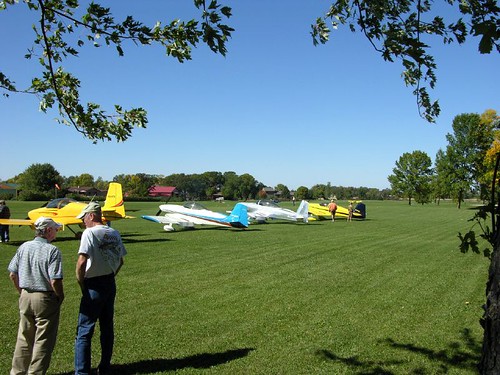
Today was a perfect day in Minnesota. And so a bunch of RVers from the Minnesota Wing of Van's Air Force got together for one. Unfortunately, I wasn't one of them (went to the Minnesota Zoo), but Doug Weiler of Hudson has captured some pictures. Apparently I'm one of the few RVers in Minnesota with a tip-up canopy on my RV.
Overdeburring
There is a pretty good blog out there, Aircraft Tools, for those of you who are also building an RV. It's a darned interesting read and I recommend it as a daily stop on Planet RV.
In today's post, the writer discusses the Cogsdill deburring tool, which some people swear by because you can do it all in one pass. There's some merit to that if you've ever deburred large skins; you have to do one side, turn it over and then deburr the hole on the other side.
The writer is not impressed, however:
Personally, I don't believe that Van's "overemphasizes" deburring. In fact, I think they've gone out of their way to caution against it. A couple of turns, is the advice I've often seen.
But what confused me about the post is making an apparent reference to using a deburring tool to create perfect holes. That's not what a deburring tool is for.
For more information: PlaneTools.com - When clecoes don't hold due to over-deburring. This company -- Isham -- recommends you not use a deburring tool at all. Oh, now you tell me.
In today's post, the writer discusses the Cogsdill deburring tool, which some people swear by because you can do it all in one pass. There's some merit to that if you've ever deburred large skins; you have to do one side, turn it over and then deburr the hole on the other side.
The writer is not impressed, however:
The RV tool kit does not include these deburring tools. The reason for this is that the rivet holes can be easily over-deburred with these tools. This causes the cleco temporary fasteners not to hold after the rivet hole is countersunk.
Personally, I don't believe that Van's "overemphasizes" deburring. In fact, I think they've gone out of their way to caution against it. A couple of turns, is the advice I've often seen.
But what confused me about the post is making an apparent reference to using a deburring tool to create perfect holes. That's not what a deburring tool is for.
For more information: PlaneTools.com - When clecoes don't hold due to over-deburring. This company -- Isham -- recommends you not use a deburring tool at all. Oh, now you tell me.
Subscribe to:
Posts (Atom)