Thursday, November 21, 2013

How planes land at wrong airports

(Cross posted from the day job)

A few years ago, I took an MPR News website producer for a ride in an airplane to show him his colleague's outstanding airmanship.

This is our approach to the airport in South St. Paul at the time. As we approach the Wakota Bridge, the speed is good, the engine is performing normally, seat belts secured, and it looks like this will be an uneventful landing. There's just one slight problem...


That's not the airport in South St. Paul. That's the downtown Saint Paul airport five miles away. The actual airport -- the runways point in roughly the same direction as most runways in Minnesota do -- is just off our left wing. I had, obviously, mistaken the two airports.

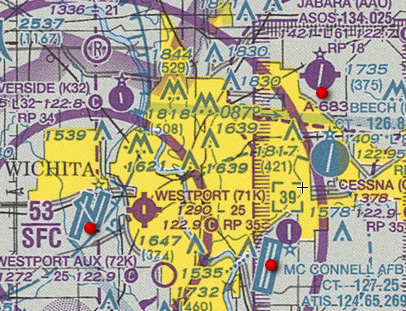
It happens, although usually not with a 747 cargo jet, like the one that landed by mistake at Wichita's Jabara Airport last night. It was supposed to land at McConnell Air Force Base, just a few miles away. The runways face the same direction. Stop me if you've heard this story before.

Here's the sectional map of Wichita that pilots refer to:


The goal of a flight crew is to match -- in the dark -- the lights below (on the map, the yellow indicates the pattern of the lights of Wichita) and the flickering lights of a runway (which can be extremely difficult to pick out when you're flying at night) and select the right one. They selected incorrectly, obviously.

There's no tower at the airport they landed at so there was no one to ask for permission to land and no one to say "you're at the wrong airport."

Sure, there are instruments that the pilots could've used -- and probably even an autopilot -- to land the jet at the right airport, but sometimes pilots like to fly the old fashioned way: by themselves. And, afterall, wasn't the news just talking about the problem of pilots being too dependent on computers?

There's not much you can do after landing at the wrong airport but say "whoops" and check the job listings.

The early news stories made a bigger deal out of the "problem" of getting the jet out. CBS, for example, said the plane was stranded because the runway is too short:

A Dreamlifter is supposed to need a runway 9,199 feet long to take off at maximum takeoff weight, and 7,000 feet to land at maximum landing weight. The runway at Jabara is 6,101 feet long.

That's an easy one to solve. Don't be at maximum takeoff weight. Take everything out (we don't even know if was carrying anything), point the thing in the right direction, and takeoff. They might have already done it by the time you read this.

The incident is similar to one last year when an Air Force cargo plane landed near Tampa, at a small airport half the size of the one in Wichita.


It took a few days to strip the plane of much of its weight.

"There's no way" they'll get the plane off the ground again, the person who took the video said.

Way.


Planes are built to fly; they don't know they're in the wrong spot.

Dbag plane buyer stories

Because I've discovered this last-ditch procedure that the FAA might -- might -- look favorably upon, I won't be selling the plane in the next few months; not until I find out whether this works (the procedure is scheduled on 12/4) and the FAA gives me a special issuance. It would be insane not to wait to see if it pays off.

I mentioned that last night to a really nice gentleman who called from Des Moines and has been looking at RVs. I mentioned the situation but said I'm still showing the plane because it might have to go. That didn't disappoint him at all and I'm hoping he can fly up to see it in the not-too-distant future. Having the plane go to a good home, if it has to go, is very important to me and you can tell a lot about a fellow-aviator in a hurry. I like him and wouldn't have a problem handing off the plane to him.

You can also tell the other kind of potential buyers in a hurry too and I'm realizing that I need a place to collect their stories, so I might as well do so here.

There are people who just want something for nothing. Granted, I'm asking a lot for the plane, but it's an airplane, a great airplane. An affordable airplane and I'll get pretty close to what I'm asking or we'll negotiate a lower price. It's worth pointing out that the plane is going into the paint shop at April 15 and that when it's done, the price won't go up. That's just the way I roll.

The first conversation you have with a buyer shouldn't be about how much you'll pay, although it does help to weed out the people you'd never want to sell your plane to.

The full listing for the plane is here. Unfortunately, Trade A Plane doesn't let you put URLs in your print ads, I guess. The print version came out this week.

2012 RV-7A, 100 TT, IO-360M1B, FP, VFR, Polished. Fiberglass unpainted but ready. D100. EIS4000, VP-50, $83,900. bcollinsrv7a@comcast.net 1712730

There's not a lot of information there, you may have noticed, so a logical first contact with a seller might include the phrase, "tell me more."

The e-mail I got yesterday didn't bother going there:
"I have a budget of $75,000. Your plane looks very nice but needs paint and cs prop. Let's discuss."

It was a pretty short discussion:

"I can't help you. You probably need to be looking for a $75,000 plane with paint and cs prop."

Tuesday, November 19, 2013

Remembering Alex Cuellar


(Courtesy of Alejandro Cuellar)

We were all enriched last week with the story of Bat Kid, the five-year-old who beat cancer and wanted to be a superhero. So San Francisco turned out last Friday to make Bat Kid a superhero. Nice story. If only they all ended that way.

Alex Cuellar of Colorado dreamed of becoming a pilot; he mowed lawns to raise money for a ride at the local airport. But then he was diagnosed with a rare brain tumor. He didn't lose his love of flying and while visiting a man who was building his own plane, he mentioned he'd like to visit Oshkosh someday, the largest gathering of pilots and planes in the world. The airplane builder put out a call for help and within a few weeks had raised enough money to take him and his father to Oshkosh.

He sent his Van's Air Force friends this note after the week-long endeavor:

Going to Oshkosh was a lot of fun; I sat in Johnny Depp's seat on the Tri-motor, got to fly in the one of a kind B-29, saw George Lucas with the Tuskeegee Airmen, and got see so many great Airplanes. The coolest part of the trip was the B-29 ride, because it had such a great view from the gunners position on the top and in the back, and you could feel the history of such an aircraft. It was the type of plane that is terrifying and peacemaking at the same time.

You all made this trip so Amazing and you will forever be in my heart.

I was hosting a daily talk show in Oshkosh and pulled him, his dad, and two RV pals who organized the effort in for a chat.

On Saturday, a memorial service was held for Alex; he died on November 9. A group of Denver-area pilots organized a fly-by in the missing man formation in the young man's honor.

Thursday, November 7, 2013

Go around!

Although we're taught that the decision to 'go around' during a landing as a matter of basic flight training, somewhere along the line it is embedded in our consciousness that this is a sign of failure: You blew the landing. Because we are human -- and quite often, I surmise, because we are (mostly) men, we don't want to "go around" and acknowledge our failure any more than we want to pull over and ask directions.

But our fellow pilots -- and us if we're not careful -- are dying unnecessarily because of this.

This morning, the NTSB released the report on a Cirrus crash last month in Illinois. It's only the preliminary information, but see if you can determine where the fate was sealed:

On September 25, 2013, about 1715 central daylight time, a Cirrus SR20 airplane, N406DC, impacted terrain after executing a go-around near Bolingbrook’s Clow International Airport, (1C5), Bolingbrook, Illinois. The pilot and one passenger were fatally injured. The airplane was destroyed. The airplane was registered to GDK International LLC and operated by a private individual under the provisions of 14 Code of Federal Regulations Part 91 as a personal flight. Visual meteorological conditions prevailed for the flight, which operated without a flight plan. The flight originated from Georgetown Scott County Airport (27K), Georgetown, Kentucky about 1500 and was destined for 1C5.

The airplane was captured on 1C5 airport surveillance cameras while attempting to land. A review of the video showed that the airplane touched down multiple times about half way down the runway. The airplane was observed making a left turn after takeoff, descending, and then proceeding out of camera view.

Witnesses reported seeing the airplane depart the runway and make a left turn at a low altitude. The airplane continued to descend, struck a tree and a light pole before impacting a parking lot and sidewalk. A post impact fire ensued and consumed most of the airplane.

The automated weather reporting station at Lewis University Airport which was 5 miles south of the accident site reported at 1715: wind from 070 degrees at 8 knots, 10 miles visibility, clear sky, temperature 21 degrees Celsius (C), dew point 9 degrees C, and a barometric pressure 29.94 inches of mercury.

During the on-scene examination investigators confirmed flight control continuity and that the flaps were in the retracted position. The Cirrus Airframe Parachute System (CAPS) rocket and parachute were found in the main wreckage. The position of the CAPS activation handle could not be verified due to thermal damage. The parachute was found in a packed state and received thermal damage. The CAPS activation cable was examined and no stretching was found.

Tuesday, November 5, 2013

They were so young

Chris Henry at EAA has spent this year reuniting old-timers with a B-17. If you follow him on Facebook, you've perhaps seen some of the individual stories brought to life by a ride on Aluminum Overcast.

Today he uploaded this.

Monday, October 28, 2013

Chair flying update

I have a safety pilot or two now who allows me to fly with N614EF again when I'm up to it, which is most of the time these days. I couldn't this weekend, so Joe, one of my new pals who's volunteered to take her out for exercise, took her out for exercise. I have to admit it's a little bit thrilling to see a plane you built flown by someone else, especially when "someone else" really seems to like it. In all the daydreaming I did in the 11 years of building, that's a scenario I never imagined.

In the meantime, the initial shock of losing my medical has worn off and I'm starting to get a feel for the post-PIC world. EAA last week announced it's accepting early purchases of Oshkosh '14 tickets and I'm inclined to buy a few, even though I have absolutely no idea how I'm going to get over there.

The plane has a date in the paint shop up in Hibbing. The particulars of the design have to be worked out, but that won't take place until around March. The quoted price is between $5,000 and $8,000. I suspect it'll be on the lower end because the paint scheme isn't really very complicated.

As far as the medical update is concerned, a friend on Van's Air Force was kind enough to send me a link to a 2007 FAA medical bulletin with a case study of someone with Meniere's Disease, involving what's known as a partial ablation using an antibiotic known as Gentamicin, which is said to stop vertigo in 60 to 80 percent of patients. It comes with risks, hearing can be further affected, which isn't a problem for me since there's very little hearing left in that ear. The alternative is a full ablation, which uses surgery to basically wipe out your inner ear, including hearing. I'm not sure what the prospects are for people with hearing in only one ear.

But, based on the FAA case study, it seems to introduce the possibility of flying again, although recovery time is quite long as you have to learn balance skills using one ear. That suggests a few weeks of discomfort (as in nausea). The flying season for '14 is probably out of the question under the best scenarios, however. We'll see. My next appointment with the neurotologist is November 13th.

I try not to get my hopes up, but flying an RV as PIC is the underpinning of most every aviation-related thought I've had for so long -- places to go, people to go with, people to meet while there. It's a hard thing to give up.

Initially, it was hard for me to even look up at an airplane flying overhead, but I'm past that now.

And speaking of that, this is a pretty neat video on flying that someone posted on VAF today. Enjoy. I was able to.

WIGY TV - Falling or Flying from Pitts Artist on Vimeo.


You'll notice in that video, by the way, the lipstick camera on the pilot's helmet is reversed. Not sure why that is.

Friday, October 18, 2013

The flyover

If you're an RV pilot, you've probably seen a lot of videos about the fabulous flyover at the Kansas City Chiefs game last weekend. I think this one provides the best perspective.


I'm not a formation guy. As a friend said, "the view only changes for the guy in front." But I certainly recognize the skill involved here.

Friday, October 11, 2013

And then what happens?

Just a quick post to update things after my letter of denial for a medical recertification  to fly. Things got a bit worse. The Meniere's problems returned in September and have been consistent enough since that I realize it's pointless to consider flying anymore. But, in the last two weeks, I've also been unable to work for a living.

There's an oddity there. When people would ask, "what do you do?", I'd say, "I fly, and I pay for it by (at least for now) writing a blog." I had great dreams of retiring soon and spending it flying here to there, maybe building Habitat houses along the way.

At the moment, I guess being able to vacuum the carpet in the living room would be a boost. Funny how things work out sometime.

I don't know how things are going to go at work. I've filed for a short-term disability which I may or may not need; we'll see at my next doctor's appointment in a week.  The place is changing, the old timers are leaving at a quickening pace,  and I can't say I've changed much with it and it's hard to imagine much of a future for someone who can't remain upright very long.

"And then what?" I find myself asking myself.

I don't have an answer.

I just know that it happened awfully fast.

I've been putting out calls for people to help "exercise" the plane in my absence. My friend, Brad, has been kind enough to fly with me last month when I was able to go up but that's not possible, at least right now. Insurance demands people with the same number of hours I've got -- about 100 -- or more and apparently people are skittish about volunteering to fly someone else's airplane, even when covered by insurance, and even when I'm paying for the gasoline. That one surprises me and reconfirms that the decision to just put the plane up for sale was probably the right one and that all the suggestions of safety pilots and volunteers to fly it while things are getting resolved are more theory than reality.

Reality bites.

Monday, September 23, 2013

Time to privatize air traffic control?

(From the day job)


Those favoring less government may be about to land a big one in their campaign. The government reportedly is considering getting out of the air traffic control business and turning it over to private industry.

The sequester, the budget failure that led to across-the-board cuts, apparently has given former opponents of privatization of the air transportation control system a reason to consider it, Bloomberg reports today.

The FAA cut $637 million from its $16 billion budget and faces more cuts next week and some people want to isolate funding air safety from politicians.

“It makes sense to examine the alternatives for operating and funding the nation’s air-traffic control system,” Craig Fuller, who stepped down as president of the Frederick, Md.-based Aircraft Owners and Pilots Association earlier this month, said in an e-mail to Bloomberg.

That’s a pretty big statement, considering that privatizing air traffic control services most certainly would come with user fees, which Fuller’s organization has vehemently opposed for years.

The model for privatizing would likely be Canada, where every flight is charged based on its weight. “After years of success, it is clear that the privatized Canadian and British systems work,” Joshua L. Schank, president and chief executive of the Eno Center for Transportation, wrote in April:

No international travelers think they should avoid British or Canadian airspace for safety reasons. Union leaders concerned about the specter of lost jobs might consider that jobs are getting hit with today’s budget cuts.

Perhaps the sequester can have a positive impact on air travel if it gets us moving toward better organization of the FAA, air traffic control and air traffic safety regulation.

Monday, September 16, 2013

Own this airplane


Update: I'm going to have some surgery on December 4 in a last-ditch effort to get a special issuance and keep flying. I don't know if it will work; some FAA contacts have suggested they may look favorably upon that. For that reason, I'm not going to sell the plane until I know it didn't work (or that it did). However, I still would be happy to show it to you so that we can expedite things in the event it has to go.


People who may/may not be interested in purchasing N614EF have asked for some more photos, so I'm happy to comply here. A few words about the plane: She will do whatever you ask it to do. She will do it without hesitation. She will make you think the wings are strapped to your body. She will go fast. She will go slow. She will be dependable. She will return more love than what you invest.

Because of this, she will only go to a home who'll respect her and appreciate the dedication and care that created her. Yes, there are dings here, and stuff that could be better there. If you're looking for a perfect airplane, she probably isn't it. If you're looking for a great airplane, this is it.

Now then, a few pictures.

Here's the interior. Gray and maroon. It was my old high school's colors. The upholstery was done by Abby at Flight Interiors.I didn't spare a lot of expense on comfort. The seat cores are Oregon Aero (they cost about $800) I think. They won't let your tush down. The seat belts are top of the line Hooker Harness five-point straps.


Here's the back of the baggage bulkhead. I've used velcro to keep it in place, although I do have the original screws and covers if you would rather go that route.


Here's an example of the kind of minor modification to enhance comfort. Underneath the carpeting in the forward fuselage are two thick layers of soundproofing foam under .063 aluminum floorboards. This eliminates any heat and vibration and creates a very solid "feel" under your feet. By the way, with all of these pictures, just click on them to see the original very large image. Oh, here also you can see I've added springs to the master cylinders. The "pucks" on the Cleveland brakes don't retreat as much as I'd like them to and  early on it felt like they were dragging a bit. The springs helped.


And here's the carpet reinstalled. Note the coverings of the gear leg towers.


It's a beautiful day to fly in Flyover Country and you could tell she'd like to. The ELT antenna is on the top, as you can probably tell. I've always like the look of an antenna stack. The bottom features a rod transponder antenna and a comm antenna that cost way too much because of the name on it.

As you can also tell, I polish it. The rest of it hasn't been painted yet, but....


This is my inspiration and plan, a classic old design with a few updates (a metallic paint, for example).


I saw that at Oshkosh a couple of years ago and headed straight for the Nuvite booth where I bought $900 worth of supplies. I would consider throwing them into a deal if you saw fit to polish. If you don't, you deny yourself some mighty inexpensive therapy.

Update: It's going into the paint shop on April 15. I decided that if I have to sell the plane, I want it to be "finished." I have no yet worked with the designers on the paint scheme, but as I indicated, it's based on the classic old Cessna design, updated to be a little jazzy, we hope. This will not affect the price of the airplane.


See the yellow spot on the wing tips. That's some filler I put in. The wing tips, at least the one on the right, is reinforced inside with some dowels epoxied into the tip. I did this after a friend reported having his wing tips damaged when someone tried to push on the wing tips. Anyway, there was a slight depression where I weighted one of the dowels, so I filled it in and smoothed it over. The paint shop will have no problem with this.

Also note the side skirts. I didn't like the Van's design that much because it leaves a gap between the canopy frame and the side step so although it's not noticeable from the outside, from the inside you can see daylight. I didn't like that so I used carbon fiber to bring the side of the canopy over the side of the fuselage. On the other side,  I also embedded the "lift" piece into the glass for a smoother appearance.


That guy in the Bonanza? He wants an RV. He never told me that, but when you fly an RV, you can tell.


Here you can see an area I built up (with balsa and fiberglass) on the top skin to get it to look better with the canopy frame. There is a gap between the two (and you can see some cracking in the old windscreen fairing, which is easily taken care of with a little sanding and some flox. It's on my list). The cabin is quite comfortable. I only have on heater unit installed so on the very coldest days in Minnesota, you want to bundle up inside. But the greenhouse effect of the canopy  makes it fairly toasty.


I used a Fairings Inc., upper intersection fairing  on the nose gear, but found the Van's fairings fit better on the upper intersection main gears. The bottom fairing on the main wheels are from Cleaveland (made in South Africa, I believe). They're bonded into the wheelpants.

One thing I did after one split last winter is I created a "lip" on the aft part of the intersection fairing to fit under the front fairing and provide more stability. On my list for winter work is to clean up the "split" a little bit and make it even tighter.


Update 10/13/13 - Completed. A little sandpaper to straighten out the seam just a tad  but otherwise, you can see the difference.


This is the panel, which VFR. It's a push-button start (to the left of the backup airspeed indicator) and backup altimeter. Above it is a warning light for the EIS 4000. I use it primarily to blink during warm up and go off when the oil temp hits 110 degrees, which means it's time to go flying. The Dynon D100 sits above the GRT EIS. To the right of that the lower toggle switches are master, flaps, on/off for the EIS (I can't recall why I did it that way) and the boost pump which can slave to either the Vertical Power (top middle) or off ship power directly. Above that is the single axis TruTrak autopilot, next to that is a fuel indicator (the GRT also has one). Above the autopilot is a toggle... the left is the mag and the right is the electronic ignition. I start it on the EI and then add the mag. Above that is the Vertical Power 50. Here's a video of that installation. To the right of that is the GPS 296 in an AirGizmo dock. Below that is an Icom A210 and below that is the Garmin 327 transponder. There's a PS Engineering 1000 intercom with a music input for an iPod (or whatever). To the right of that is the ELT remote switch and a cigarette lighter-style power supply, which I'm presently using for the Zaon traffic alert system that's atop the glare shield. A wet compass is in there only because the DAR loves wet compasses.


Did I mention it's a tip-up? And also that's she beautiful? Because of that, getting to the wiring and plumbing is super easy. There's a serial port here that  I use to update the Dynon. There's also a serial connector to log stuff coming out of the EIS 4000. Wires I'm not using (some dimmer connections, for example), I've just coiled up for future use. Oh, there is a dimmer down near the ELT remote. I put in a small LED baggage area light, and that can expand for additional lighting. Nothing fancy. In fact, there's nothing about this plane that I would call "fancy."


But, it's solid, and it's all about safety. I don't do aerobatics, but the RV-7A is structurally built to allow it. I have a lot of features  that are targeted for situational awareness. I have top of the line Hooker Harnesses.

For comfort, the cores of the seats are top of the line Oregon Aero foam for comfort.

I've also run the wire from the right wingtip where my intention has been to install an APRS tracker (one of the holes in the toggle switches stack would turn it in). I have the unit that interfaces with a GPS and I have an antenna. But since I don't have the Ham Technician Class license, I haven't put it in.

This is the latest addition. Using Mel Asbery's excellent suggestion, I made an angle of attack probe and bonded to the regular pitot, ran new plumbing to the Dynon D100 which has an optional AOL (chevron style) warning system. I don't have the audio hooked up to warn because I don't need it. It's on full display. We took it up last week to calibrate and it works fantastic!


How does it fly? You tell me.


Here's the full listing of the plane:

RV7A, N614EF, VFR panel, Tip Up, FP (Plumbing in place for conversion to CS)
S/N: 70240
Location: South Saint Paul, MN
For sale by builder/owner: Asking Price: $83,900.
Many pictures for email, build logs available (pdf) by request. A scattering of videos all over the Internet, several articles about the long process involved. Plenty of stories that can be retold.

Selling because of lost medical
TTAE: 100
First flight date: June 3, 2012

Polished. Fiberglass unpainted but would be happy to share the paint design inspiration with you. (interior grey with maroon accents via Flightline Interiors)

Engine: Mattituck (Lycoming) IO-360M1B (Injected 180HP), 100, One Slick Magneto (left side) and 1 Lightspeed EI, Skytec Starter, Vetterman Crossover Exhaust. More information on the engine is here.

Prop: Sensenich FP 85 pitch (Van's recommendation). Prop has been balanced.

Electric Flaps, manual trim (elev and aileron) as God intended, Whelen 3-point strobes, Duckworks landing lights with wigwag

Avionics: Icom A210 comm, Garmin 327 transponder (to GPS), Dynon D100. Installing AOA plumbing now, Garmin 296. TruTrak Digitrack (to GPS), VP-50 power management. 406 ELT (May 2014 battery). Zaon MRX traffic detector. Backup steam gauge airspeed and altimeter. GRT EIS 4000 with fuel flow indicator and fuel gauge. Backup (or primary if you want) EI Fuel gauge. ARTEX 406 ELT (new antenna).

Interior: Upholstery and carpets, grey/maroon by Flightline Interiors. Hooker 5-point harnesses. Portable Airox oxygen installed.

Tires/wheels: Desser Monsters (just installed) retread. New brake pads installed. Nosewheel has Matco mod. I had that fairly common "groan" when applying the left brake for awhile (you can hear it in the Oshkosh departure video). I took the caliper off and put some Disc Brake Quiet on the back of the pad holder assembly where it contacts the metal "puck" that's activated when you press the brakes. It's quiet now as the experts on VAF told me it would be.

General info: Fully loaded, it cruises at 148 ktas at 6,500 (determined on way home from Oshkosh). It's never been higher than that so I can't give you better information. Full logs and install/owner's manuals for all avionics, cockpit cover (Cleveland), and towbar. Fiberglass wheelpants, leg fairings, intersection fairings completed (some cosmetic work necessary on upper intersection fairings) but not painted. It's a pretty stock build as I learned long ago to follow instructions.

Stall speed: Flaps 48 kts, No flaps 51 kts.

Empty weight: 1121 (2 pounds over the Van's sample)

Wiring run for APRS system. APRS equipment and antenna included.

Date last annual: May 2013. Flown regularly while I could but it's never had a flight longer than about an hour and a half (to Oshkosh this year, and Madeline Island last year). Sadly, it never made it to Cleveland or New England. Everything else has been local, the equivalent of a little old lady only taking it out on Sundays.

Insurance: Presently through NationAir, with 100 hours of RV time and 300 hours of total time, I pay about $1,400 for full coverage at $80,000. YMMV.

Things I intend to do before selling: It doesn't need it but I want to change the oil again and remove the quick drain I have in there now because while tightening it last time, I crimped the safety wire holes. So I'll buy a new one and install. I also want to put a new crush gasket on the oil strainer plug. It uses very little oil but it weeps there slightly. I may connect the APRS, I want to work on the fiberglass intersection fairings a little more, and if nobody's buying, I'll be polishing anyway.

Various performance data: I don't have a great deal of nerdy data because we haven't been on a lot of long flights. Generally at about 4500 feet I lean out to about 7.5 gph, doing 146 knots (give or take) indicated at about 2400 RPM. I climb out at about 95 or 100 knots  because to go any slower means I've got the nose high and I like to be able to see things in front of me.  Slowing down an RV with a FP isn't as bad as some people like to make it as long as you've read Stick and Rudder and understand power and pitch. It's that simple. With this plane, you'll feel like you're wearing wings. Trust me on this.

The terrific Tom Berge did several inspections during construction, did the final inspection before I had DAR Tim Mahoney do that, and Tom did the first flight and said, "congratulations, you've got a fine airplane." Tom doesn't lie about these things and he's got high standards. The flight test data you can find here. Tom would make an excellent pre-buy inspector, and can also provide you with outstanding transition training.  It's in nobody's interest that you not feel completely comfortable in this aircraft.

I'm not going to lie to you; I don't want to sell this plane. She and I have been together through some good and challenging times. There are pieces of people all over her (and here). I can't tell you how much she means to me and how much I want her to mean to the next owner. If that happens to be you, I sure would appreciate your stopping by every now and again and let me go for a ride.

Also, if you're in the Twin Cities area and would be interested in a fractional ownership, I don't really know how they work but would be willing to investigate and consider it.

Contact Info: Bob Collins, bcollinsrv7a@comcast.net, c: 651-470-6371

Tuesday, September 10, 2013

The FAA lowers the boom

Five months after my FAA medical renewal exam, and having jumped through all the subsequent hoops, the Federal Aviation Administration sent me a letter today saying my request was denied. My flying days are over.

I can reapply in six months, but there's nothing in the FAA decision that gives me any hope. The FAA surgeon's opinion of not having any underlying medical condition now or in the future extinguishes that. I have Meniere's Disease and although the FAA gave me a medical renewal two years ago knowing that, this time they didn't. There's no cure for Meniere's, you have it. I recently started using a Medtronic device which is said to control symptoms, but from what I gathered from today's letter is that even using the device suggests symptoms and, hence, there's no qualification to fly.

I think I can accept that. I think I can go through with the process of selling N614EF OK, if I can find a buyer. Curiously, the one thing I find most difficult to accept is that me, five or six years from retirement, who's been looking forward to retiring for years, has nothing, really, to look forward to in retirement.

I don't have another recreational passion besides aviation. I guess I need to find one.


Monday, August 12, 2013

Slick does it again

I'm not sure I'm ever going to get around to writing up my Oshkosh trip report; on the whole, my experience wasn't much different than others, other than I flew into the dogfight orderly flow at Ripon for the first time.

So maybe we'll just do what we've done in previous years, and let Slick Hutto put the exclamation point on Oshkosh. Because he's done it again.


Update: And now, the "10 minutes of AirVenture" series begins:

Tuesday, August 6, 2013

The ballooner

One of the neat moments I had at Oshkosh this year was meeting Noah Forden of Rhode Island. As it so happened, he was camping just a short way from us in the homebuilt-camping section.

Noah is a ballooner and also owns an RV-7. But a big balloon doesn't fit in an RV, so he built a smaller balloon.


So you get cool views like this (pictures courtesy of Noah):


And this:


All from this:

RV Aerobatics at Oshkosh

But not by me, of course.

Sunday, August 4, 2013

Home from Oshkosh


I think every pilot has a common theme: To one day fly into Oshkosh.

Thanks to my pal, Brad Benson, that happened for me on Thursday when we flew in. I will be putting together a long post on the days we spent there soon but one of the benefits of doing this -- especially with someone in the right seat who's done it before -- it it provides a great confidence boost.

We left this morning. Sunday is pretty abandoned at Oshkosh so you'll just have to imagine about 50 times as many planes floating around as what you see here, but this is a good tour of the taxi from homebuilt camping down to Runway 18.


Tomorrow I have another doctor's appointment and some new gizmo has arrived from Medtronic. I'm feeling great and I'm ready to get to work giving the FAA what they need to get my renewal.

I just flew into the busiest airport in the world; I can fly anywhere.
Share |